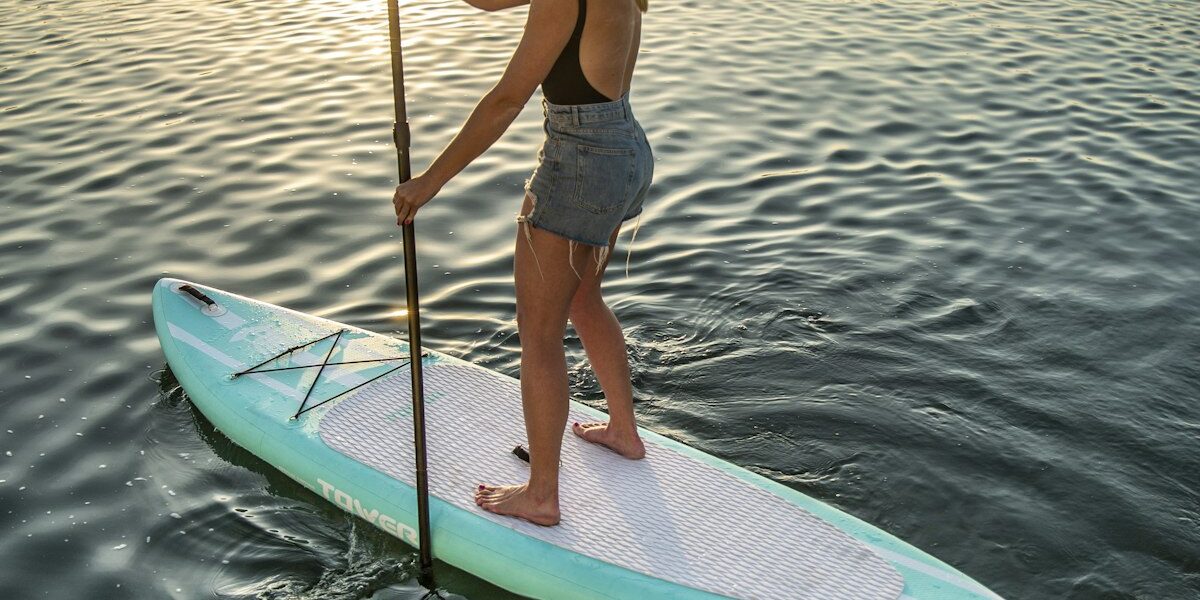
To learn stand-up paddleboarding, begin on protected shallow water, wear a properly fitted life jacket, use a location-appropriate leash, start on your knees, stand one foot at a time near the board’s center, and practice falling and remounting before paddling away from shore.
This article includes affiliate links. We may earn a commission at no extra cost to you.
This is a general introduction, not a substitute for local instruction. Moving water, surf, cold water, offshore wind, boat traffic, and remote locations require additional judgment and skills.
Beginner SUP equipment
- Stable board: enough volume and capacity for paddler, clothing, and gear.
- Adjustable paddle: configured according to the manufacturer and comfortable for the intended stroke.
- Life jacket: Coast Guard-approved, correct size, suitable for the activity, and worn.
- Leash: selected for the specific water; moving-water systems need appropriate instruction.
- Clothing: chosen for water temperature and immersion, plus sun and foot protection where needed.
- Communication: whistle and protected phone, VHF radio, or other location-appropriate device.
Read the complete SUP safety and equipment checklist before the first session.
Choose the first location
Use calm, protected water with an easy launch, minimal current, little boat traffic, no breaking surf, and multiple places to get out. Stay close to shore. Check wind, gusts, storm risk, visibility, water temperature, and local notices. Our best paddleboarding weather guide explains why wind direction and immersion risk matter more than a single forecast icon.
Set up the board
- Inspect the board, fin, valve or vent, paddle, leash, and life jacket.
- For an inflatable board, use the manufacturer’s pressure range and close the valve correctly.
- Install the fin fully and verify its retaining system.
- Adjust the paddle according to its instructions; avoid treating one generic height formula as universal.
- Secure only gear that will not interfere with falling, remounting, or releasing the leash.
How to get on
Carry the board into water deep enough that the fin will not strike bottom. Approach from the side near the center handle. Place the paddle across the board, hold the rails, and bring one knee and then the other onto the deck. Center your knees around the carry handle and look toward the horizon.
Paddle on your knees until the board feels predictable. Learn to stop and turn before standing. If wind or current is already carrying you away from the safe area, return immediately.
How to stand
- Place the paddle across the board in front of you for support.
- Move one foot at a time to where each knee was, straddling the center handle.
- Keep feet roughly parallel, knees soft, chest up, and eyes ahead.
- Rise gradually rather than pulling on the paddle.
- Once stable, place the blade in the water; an engaged paddle adds a point of support.
Do not stare at your feet. Small ankle and knee movements are normal. If balance deteriorates, lower to your knees before the situation becomes uncontrolled.
Basic forward stroke
Reach forward without collapsing posture, place the blade fully in the water, and draw the board past the blade. Exit near your feet rather than dragging the blade far behind. Keep the top hand over the shaft and use torso rotation instead of pulling only with the arms. Switch sides as needed to maintain direction.
Stop and turn
To slow down, place the blade behind you and apply controlled resistance. A reverse stroke can stop and begin a turn. For a wider sweep turn, reach forward and arc the blade away from the board toward the tail. Practice both directions while kneeling first.
Practice falling and remounting
Fall away from the board and paddle rather than trying to catch yourself on the deck. Protect your head and avoid diving into unknown depth. Keep hold of the paddle if practical, but prioritize avoiding impact.
To remount in calm water, approach the side near the center, place the paddle where it will not block you, reach across the board, kick your legs near the surface, and pull your chest onto the deck before rotating back to kneeling. Board design, clothing, waves, fatigue, and gear change the technique. Practice beside shore with supervision.
Common beginner mistakes
- Launching in offshore wind because the water near shore appears calm.
- Standing before learning to stop, turn, fall, and remount.
- Looking at the feet and locking the knees.
- Holding the paddle backward or using only the arms.
- Traveling farther than the paddler can swim, remount, or kneel back from safely.
- Using an ankle leash in snag-prone moving water without appropriate training.
- Dressing for warm air while ignoring cold water.
First-session progression
Spend the first outing mastering control within easy swimming distance of shore: kneel, paddle straight, stop, turn both ways, stand, return to kneeling, fall, remount, and land under control. Distance comes later. A lesson from a qualified local instructor can shorten the learning curve and address hazards specific to the waterway.
Official references
- U.S. Coast Guard Boating Safety FAQ
- National Weather Service cold-water safety
- National Weather Service inland boating guidance
Safety references checked August 2, 2026.
After you can launch, stand, turn, stop, and remount under control, build a smoother catch and exit with the SUP forward-stroke practice guide.
Interested in an instructor-led specialty class? Review the prerequisites and venue checks in our beginner SUP yoga safety guide.
Wondering whether the activity will suit you? See why people enjoy paddleboarding, then use this guide for a controlled first session.
Before setting up the board, use the beginner paddleboarding location checklist to screen access, launch, traffic, weather, route, and rescue conditions.
Before going beyond easy swimming distance from shore, practice the SUP self-rescue and deep-water remount sequence in controlled conditions with a partner.

Stay in the loop
Get the latest sup spots updates delivered to your inbox.