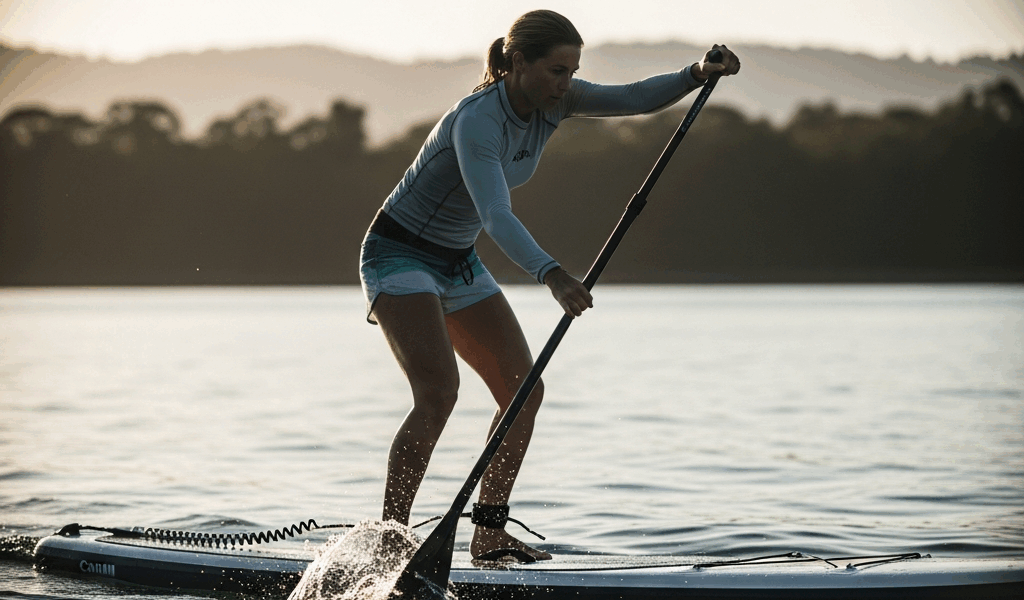
An efficient SUP forward stroke moves the board with a clean blade plant, useful body rotation, and an early exit—not a harder pull with tired arms. Technique varies with board, paddle, pace, water, mobility, and coaching system, so treat the sequence below as a practice framework rather than a single mandatory style.
Learn on calm, protected water with room to drift, wear appropriate safety equipment, and stop if a drill causes pain, numbness, dizziness, or loss of control. A qualified instructor can give feedback that a written guide cannot.
Set the Board and Paddle First
Stand near the board’s intended trim point, commonly around the carry handle, with feet comfortable and knees relaxed. Look toward the route instead of down at the deck. Hold the top grip with one hand and the shaft with the other; when switching sides, switch both hands.
Many SUP blades angle forward from the shaft when held correctly. Check the paddle maker’s instructions because blade shapes differ. An adjustable paddle should lock securely and be sized for your body, board thickness, discipline, and comfort. Start with the SUP paddle-length fitting guide, then fine-tune on the water.
The Forward Stroke: Catch, Power, Exit, Recovery
1. Catch
Reach only as far as you can while staying balanced and organized. Place the blade near the rail and immerse it before applying meaningful force. A partial, splashing plant can slip through the water; an overextended reach can pull your posture apart. Seek a quiet, repeatable catch.
2. Power
Connect the paddle to the board using the trunk and larger muscle groups instead of curling mainly with the lower arm. Keep the shoulders relaxed and avoid locking joints. Think of moving the board past the planted blade. The exact amount of hip hinge, knee movement, and rotation changes with pace and paddler.
3. Exit
Release the blade around the feet rather than continuing far behind the body. A late exit often lifts water, pulls the board off line, and puts the shoulder in a less useful position. The right exit point is the one you can repeat without losing posture or balance.
4. Recovery
Relax pressure on the blade, bring it forward with minimal clearance, and reset for the next catch. The recovery is your chance to release unnecessary grip tension. If hands and forearms fatigue first, check whether you are squeezing the shaft or pulling mostly with the arms.
Five Common Problems and Corrections
The Board Zigzags
First check that the fin is installed correctly, the load is centered, and wind or current is not driving the nose. Place the blade closer to the rail and keep the shaft more vertical from the front. Switch sides before the board turns far off course. Advanced correction strokes are useful, but a clean forward stroke should come first.
The Blade Splashes or Slips
Slow the sequence down. Immerse the blade before applying power, then build pressure progressively. Do not try to fix a weak catch by yanking harder.
Shoulders or Elbows Tire Quickly
Reduce intensity and check paddle length, hand spacing, grip tension, and exit timing. Use comfortable trunk rotation and avoid forcing range of motion. Persistent or sharp pain needs assessment by an appropriate health professional, not another technique cue.
The Nose Bobs With Every Stroke
Check fore-aft trim and avoid pulling beyond the feet. Keep force directed into forward propulsion rather than levering downward late in the stroke. Cargo position can also change trim.
One Side Feels Much Worse
Practice slowly on both sides. Film short passes from the front and side if it is safe to do so, then compare hand switch, blade plant, shaft angle, posture, and exit. Significant or painful asymmetry deserves individualized coaching or clinical advice.
Four Low-Risk Technique Drills
Quiet-Catch Drill
Paddle at easy effort and listen. Pause just long enough to immerse the blade cleanly before loading it. Aim for less splash without exaggerating the reach.
Exit-at-the-Feet Drill
Place a visual reference near your feet and release the blade as it reaches that area. Compare how the board tracks and how the shoulders feel. Do not stare at the marker while moving; keep scanning the route.
Slow-Motion Drill
Perform the complete catch-power-exit-recovery sequence at reduced speed for a few strokes per side. Smooth transitions matter more than force. Return to normal paddling before balance deteriorates.
Straight-Line Drill
Choose two fixed shore references that form a safe line. Paddle at conversational effort and count how many clean strokes you can take before a side change is needed. The goal is controlled tracking, not an arbitrary number of strokes.
Cadence and Power Are Contextual
A touring pace, sprint start, surf approach, and headwind do not use identical timing. Higher cadence is not automatically less efficient, and fewer strokes are not automatically better. Efficiency means producing the needed speed and control with sustainable technique for the task.
Change one variable at a time: cadence, reach, blade size, paddle length, or effort. Use a repeatable short route in similar conditions and judge not only speed, but tracking, breathing, perceived effort, and discomfort.
When to Get Instruction
Seek hands-on coaching if you cannot paddle and stop under control, repeatedly fall during drills, plan to enter surf or moving water, or have recurring pain. The American Canoe Association’s SUP curriculum treats forward strokes as part of a larger skill set that also includes board trim, stops, turns, bracing, rescues, and venue judgment.
Practice Checklist
- Paddle and fin are correctly assembled.
- Board trim and stance are stable.
- Blade enters cleanly near the rail.
- Power begins after the blade is immersed.
- Trunk and legs contribute without forced motion.
- Blade exits near the feet.
- Grip relaxes during recovery.
- Both sides receive controlled practice.
Technique References
- American Canoe Association Level 2 SUP instructor criteria, including stroke phases, body use, board trim, and effective forward techniques.
- Starboard basic SUP paddle-stroke guide, including balance, blade plant, exit, and hand switching.

Stay in the loop
Get the latest sup spots updates delivered to your inbox.