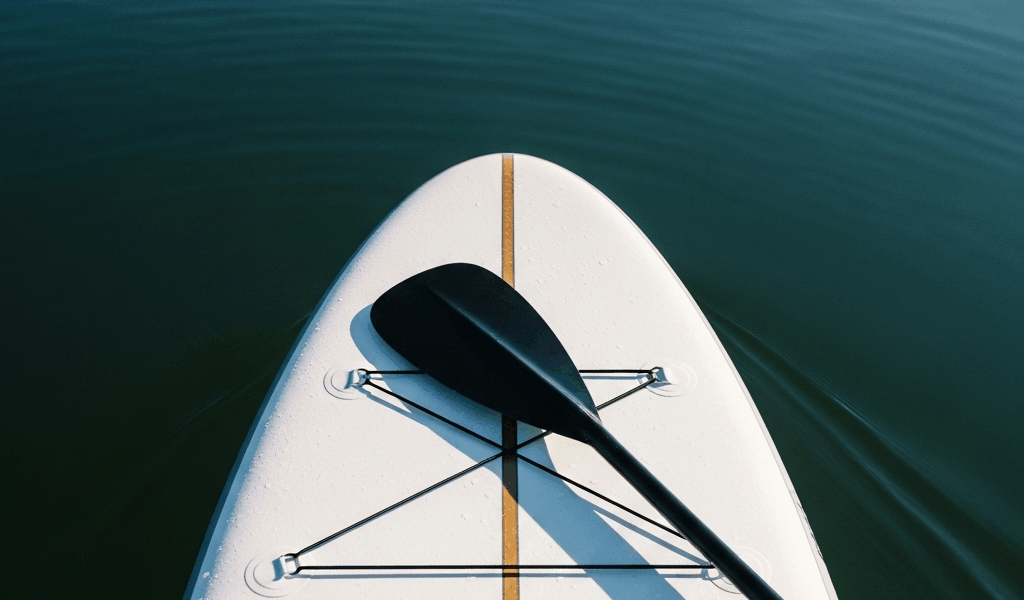
What Backward Drift Actually Means
Backward drift has gotten complicated with all the conflicting advice flying around. I spent my first three months on a stand-up paddleboard thinking I was the problem. Every time I pushed off from the dock, I’d watch the shoreline creep backward — and honestly, it was infuriating. Paddling backward in flat water is one of the most frustrating experiences in SUP, and it’s also one of the most misdiagnosed.
But what is backward drift? In essence, it’s when your board’s stern (the back end) moves away from your intended direction faster than the bow (front) moves forward. But it’s much more than that simple definition.
Here’s the thing: you might not actually be moving backward at all. What you’re experiencing could be one of three completely different problems. First, true backward movement — the board literally goes in reverse. This is rare in flat water and usually means something’s seriously wrong with technique or equipment. Second, momentum loss — you paddle hard but the board slows down dramatically between strokes. Third, tracking failure — the board won’t hold a straight line and constantly wants to pivot sideways, which feels like drift when it’s actually rotation.
Probably should have opened with this section, honestly. Most guides blame the paddler. But backward drift has structural causes rooted in board design that technique alone can’t fix. The real answer lives somewhere in the middle — your board’s physical properties and your stroke mechanics are both culprits.
Board Design Factors That Cause Drift
The rocker profile of your board is the single biggest design factor influencing drift. Rocker is the curve running lengthwise from nose to tail. Picture it this way: a board with aggressive rocker curves upward dramatically, especially at the tail. This design sacrifices speed for maneuverability — the tail lifts out of the water easily, which is great for turning but terrible for forward momentum.
Boards with minimal rocker sit flatter on the water. They want to go straight and stay straight. But — and this matters — a perfectly flat rocker can feel unstable if your balance is off, because any weight shift gets amplified by the lack of curve.
Tail design works alongside rocker to determine drift behavior. A rounded tail (pin tail) has less surface area pushing against the water. A squared-off tail grips the water more aggressively. Most all-around boards split the difference with a subtle square-pin hybrid. Touring boards usually lean toward squared tails for stability — think 29-32 inches wide with a 4.75-inch thickness. If your tail rounds too much, water slips past it more easily, and you lose tracking.
Volume distribution matters more than total volume. A board with 120 liters of volume concentrated in the nose and middle is fundamentally different from a 120-liter board with balanced volume front-to-back. Nose-heavy boards naturally want to dive. Tail-heavy boards want to lift at the back and lose contact with the water — this is where visible backward drift happens. You’re not moving backward; the tail is slipping sideways and down.
Width and thickness are secondary factors, but don’t ignore them. A narrower board (under 28 inches) naturally tracks better because there’s less board to fight water resistance. A thicker board (over 4.5 inches) has a higher profile above water, which catches wind more easily. Wind is not drift, but it compounds it. I learned this the hard way during a windy day on a thick, wide beginner board — I thought I was weak. Turns out I was fighting 12 knots of wind with a 32-inch board that caught every gust.
The bottom contour — whether the board has a flat, V-shaped, or rounded bottom — influences how water flows around the tail. Flat bottoms are stable but can catch and swing. V-bottoms reduce that catch but require better technique to stay upright. Rounded bottoms split the difference.
Paddling Technique Mistakes That Look Like Drift
Your catch is where the paddle enters the water. A late catch — where you bury the blade too far back along the board — kills forward momentum before it starts. Your body rotates, your core engages, but the paddle isn’t anchoring the board forward. Instead, it’s pulling the board sideways or downward. The stern drops. You feel backward drift.
Here’s a quick test: take five normal strokes, then on the sixth stroke, catch the paddle about 12 inches further forward — near your feet instead of at hip level. Notice the difference? Forward strokes should feel like you’re pulling the board over the paddle, not pulling the paddle past the board. If you can’t feel that anchor point, your catch is too late.
Shaft angle matters, too. If you’re holding the paddle too vertically (straight up and down), you’re pushing water down instead of backward. The blade should reach forward slightly, then pull back at roughly 45 degrees from vertical. A vertical shaft also keeps your hands lower, which reduces leverage and core engagement.
Stroke timing creates drift through momentum gaps. If you pause too long between strokes, the board decelerates. That gap is where backward drift sneaks in — not because you’re moving backward, but because you’ve lost the forward push and water resistance starts pulling the stern down. Experienced paddlers maintain continuous momentum by overlapping strokes slightly. No pause between left and right.
Weight distribution is the silent killer. Standing too far back on the board — even just 6 inches — sinks the tail into the water. Increased drag on the tail means decreased forward speed. This is especially true on lightweight boards under 120 liters. I once switched to a narrower racing board and immediately felt like I was drifting backward. The issue: I was standing in my touring board stance (centered), which put too much weight toward the tail on a narrower platform.
Over-rotating your core can also create false drift. You twist your torso aggressively, thinking you’ll generate more power. Instead, you’re rotating the board sideways slightly with each stroke. The board pivots instead of moving forward. Paddlers often mistake this rotation for backward drift because the bow yaws left and right while the stern seems locked.
How to Fix Backward Drift on Your Current Board
Start with foot position. Stand with your feet parallel, shoulder-width apart, centered on the board — or slightly forward if the board has tail-heavy volume distribution. Your weight should rest on the balls of your feet, not your heels. Heels back equals weight back equals tail down. If backward drift stops when you stand forward, the board design is tail-heavy, and you’ve found your fix.
Adjust your catch point next. Place your paddle blade in the water as close to your feet as you can reach without bending forward dangerously. The blade should be fully submerged. Pull straight back — not in a wide arc outward, but along the centerline of the board. This creates a direct forward vector instead of sideways pull.
Shorten your stroke length. Paradoxically, paddlers often respond to slow forward progress by reaching further back. This extends the stroke duration and increases the pause between strokes. Shorter, more frequent strokes maintain momentum better. Rhythm matters more than reach.
Keep your shaft angle at roughly 70-80 degrees from horizontal (not vertical). Lean into the paddle slightly. Your shoulders should be ahead of your hips at catch. This posture transfers body weight forward instead of keeping it stacked above your feet.
Don’t move too far forward. I see paddlers compensate by standing way up near the nose. This improves tracking temporarily but makes the board unstable, kills your power position, and exhausts your legs. Move forward just enough to balance tail-heavy volume — usually 4-6 inches from center.
Practice the “feel test” on flat water with no wind. Paddle for 20 seconds at normal pace. Notice where you stand, where your paddle catches, and how long the pause is between strokes. Now deliberately stand 6 inches back and repeat. Paddle with a late catch and repeat. You’ll feel the difference immediately. That kinesthetic memory is your best diagnostic tool.
When Drift Means You Need a Different Board
If you’ve adjusted foot position, improved your catch, and maintained steady rhythm, and backward drift still persists, the board might not match your paddling style or body type. That’s worth investigating.
Weight matters. If you’re over the maximum weight recommendation for your board, the tail will sink. A 200-pound paddler on a 100-liter board will always feel tail-heavy, no matter the stroke technique. Check the board’s weight capacity — honestly, not aspirationally.
Rocker profile is the next checkpoint. If your board has a pronounced rocker (you can see the tail curve upward when you look at it from the side), you’ve chosen a turning-focused board. These boards prioritize maneuverability over tracking. They’ll always feel slower and require more active steering. If you want straight-line speed, a flatter rocker is non-negotiable.
Volume distribution is the upgrade consideration. Look for boards with balanced or slightly forward-biased volume. Touring boards typically distribute volume evenly nose-to-tail or with a subtle taper. All-around recreational boards often cluster volume in the middle. Racing boards frontload volume intentionally. If your current board feels tail-heavy even after stance correction, a different volume distribution could be the answer.
Tail design matters if your board has an aggressive pin tail (rounded, pointed stern). Squared-off tails grip the water better and reduce drift-like behavior. This is especially true for lighter paddlers who need extra surface area to stay engaged with the water.
Before you buy, rent or borrow a board with a flat rocker, squared tail, and balanced volume. Take it out on the same flat water where you felt drift. If backward drift disappears, it’s a gear problem, not a technique problem. If drift persists, technique is your culprit.
The honest truth: most people fix drift through technique adjustments. Better catch point, stronger rhythm, and proper foot position solve 70 percent of drift complaints. The remaining 30 percent genuinely need different equipment. Knowing which camp you’re in saves money and frustration.


Stay in the loop
Get the latest sup spots updates delivered to your inbox.