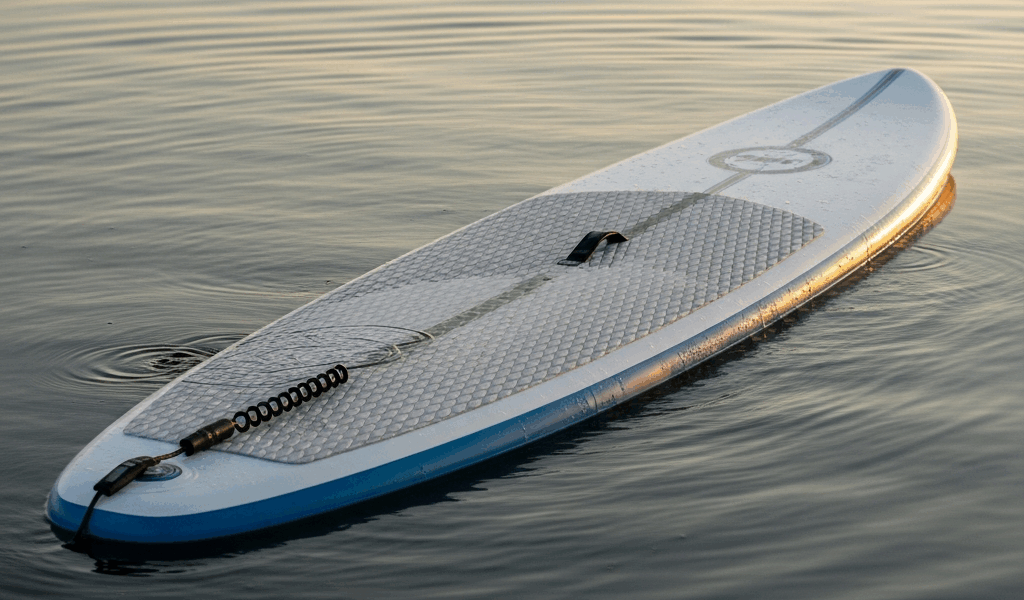
Why Your SUP Board Sinks in the Back When Standing
I’ve watched this happen a hundred times at the lake. Someone paddles out on their shiny new SUP board, stands up, and immediately the rear half drops lower in the water while the nose lifts slightly. They shift their weight around frantically, lean forward, lean back — none of it helps. Within minutes they’re sitting back down, convinced the board is defective or undersized.
Here’s what I’ve learned through way too many hours on the water: why your SUP board sinks in the back almost never comes down to the board itself. It’s weight distribution, stance, or board volume — and I can show you exactly how to figure out which one is actually causing your problem.
Weight Distribution Matters More Than You Realize
Struggling with that rear-end submersion? Start here. Most paddlers stand too far back on their boards without even realizing it.
When you stand on a SUP, your weight placement determines everything about how the board sits in the water. Position your feet too close to the tail, and you’re applying downward force on the rear third of the board. That concentrated load pushes the back end under while the front pops up. Move those same feet six to eight inches forward, and suddenly you’ve redistributed your weight toward the center of buoyancy. The board flattens out.
I made this mistake for an entire summer. I stood where it felt natural — close to where I could grip the handle or see my board better. Turns out I was standing roughly 18 inches too far back. The fix took maybe thirty seconds once I understood what was actually happening.
Here’s how to recognize where your weight actually is: Pay attention to pressure on your feet while standing. You should feel even pressure across the entire foot, with maybe slightly more toward the center of the board. If you feel pressure concentrated on your heels and the ball of your foot is light, you’re standing too far back. If pressure is heavy on your toes, you’re forward. Neutral pressure — heel to toe — means you’re centered.
Volume doesn’t matter if you’re standing on the wrong part of the board. A 200-pound person on an oversized board can still sink the back if they stand eight feet from the nose instead of five feet from it. The board has the flotation. The rider just isn’t using it correctly.
Check Your Board Volume Against Your Actual Weight
That said, board volume absolutely matters. But most people have no idea whether their board is actually sized correctly for them.
The simple formula: Take your body weight and add 10 to 15 percent buffer. That’s your minimum board volume in liters. A 180-pound paddler needs at least 198 to 207 liters to float comfortably with zero weight on the board. In reality, you want a few extra liters for stability and margin.
Undersized boards sink the back because they don’t have enough total flotation to support your weight plus the leverage effect of standing. When you’re centered on a board that’s barely adequate for your weight, the entire board sits lower in the water. Add any forward momentum or chop, and hydrodynamic forces pull the tail under faster.
Check your board’s spec sheet. It should list volume in liters. If it doesn’t, measure: length × width × thickness × 0.62 gives you a rough estimate. A 10′ board that’s 30 inches wide and 4.5 inches thick is roughly 173 liters.
Now compare that number to your weight. Probably should have opened with this section, honestly. I’ve seen so many people blame their stance when they were actually riding boards that were off by 20 or 30 liters.
Volume matters most in flat water or when you’re stationary. In choppy conditions, a properly positioned rider on an adequate board handles rear-sinking better because weight distribution becomes more critical than pure volume. But if your board is genuinely undersized — and you’re 200 pounds on a 160-liter board — no stance adjustment will fix it completely.
Foot Placement and Stance Width Fixes
Assuming your board has adequate volume, foot placement is your control knob.
Optimal stance: feet shoulder-width apart (roughly 16 to 18 inches for most people), centered on the board. “Centered” means roughly equidistant from both the nose and tail. For a 10-foot board, that’s around the 5-foot mark from the nose. Your feet should straddle the board’s centerline without being cramped against it.
Now, shoulder-width doesn’t mean rigid. It means your feet have enough lateral separation to create a stable base without your legs fighting each other. Too narrow and you’re balancing on a tightrope. Too wide and you’re fighting to keep the edges from catching.
If you’re tall — over 6’2″ — your stance might need to be slightly wider to maintain stability. If you’re short, under 5’5″, a narrower stance often works better because you have less rotational moment around your center of gravity. Experiment within a range of 14 to 20 inches and find what lets you stand without thinking about balance.
Then — and this is critical — keep your feet still once you find the right position. Shuffle-standing (moving your feet around while paddling) throws off your center of gravity constantly. Pick a spot, commit to it, and only adjust if the board starts tipping sideways or sinking consistently on one end.
I watched a woman on a well-sized 160-liter board sink the back because she was literally shifting her feet forward and backward with each paddle stroke. She’d move back to brace, forward to paddle, back to brace. The constant shifting meant she never actually centered her weight. Static feet, even if slightly off-center, work better than dynamic feet that are theoretically more centered.
How Fin Setup Contributes to Rear Sinking
This gets technical, but stay with me.
Your SUP’s fin influences pivot and hydrodynamic pressure distribution. A larger fin creates more drag and requires you to stand more forward to overcome that drag comfortably. Smaller fins reduce drag, which means you can stand slightly farther back. This happens because fin pressure — the water pushing up on the fin — shifts depending on fin size and rake (the angle of the fin).
If your board came with a large, upright fin and you’re a beginner, you might need to stand a foot farther forward than the board’s “center” to reduce the effort of turning. If someone installed a small racing fin, the pressure distribution changes, and you might sink the back because you’re standing in a position optimized for the old fin.
Foil matters too. A thin, knife-like fin profile has a different pressure curve than a thick, blunt profile. Neither is wrong, but they affect where you need to stand for the board to track straight without excessive drag.
If you’ve diagnosed a weight distribution issue and fixed it, then tried a different fin, you might need to re-tune your stance. This is rare for beginners, but experienced paddlers swap fins constantly and adjust their positioning each time.
Most stock SUP boards come with fins that are neutral enough that a centered stance works across the board. But if you’re standing in the right place and still sinking the back on your specific board, check what fin is installed. If you inherited the board or it came used, the fin might not be original.
Quick Diagnostic Test You Can Do Right Now
Here’s how to isolate your problem in under five minutes on the water.
Step 1: Paddle to flat water, at least 50 feet from shore. Conditions should be glassy.
Step 2: Stand centered on your board where you normally would. Observe how the board sits. Does the back third sink noticeably lower than the front? Write down what you observe or take a photo from the side.
Step 3: Move your feet forward exactly 12 inches. Measure this with your board’s markings if it has them, or count foot-lengths. Stand still for 10 seconds.
Step 4: Compare. Does the board sit flatter? Does the tail come up?
If yes — the board flattens noticeably when you move forward — your problem is weight distribution. You were standing too far back. Adjust your stance forward by 8 to 12 inches permanently, and your rear-sinking issue is solved.
If no — the board barely changes and still sinks the back — suspect volume or fin issues. Your weight distribution isn’t the primary culprit. Measure your board’s actual volume, compare it to your weight plus 10-15%, and if it’s marginal, that’s your answer. If volume is adequate, test with a different fin size or consult your board’s manufacturer about fin recommendations for your weight.
That test takes 90 seconds and eliminates guesswork. Once you know whether it’s stance, volume, or fin setup, you know exactly what to fix. Most of the time — maybe 75% of cases I’ve seen — it’s stance. But running the test means you’ll never waste time chasing the wrong solution again.


Stay in the loop
Get the latest sup spots updates delivered to your inbox.