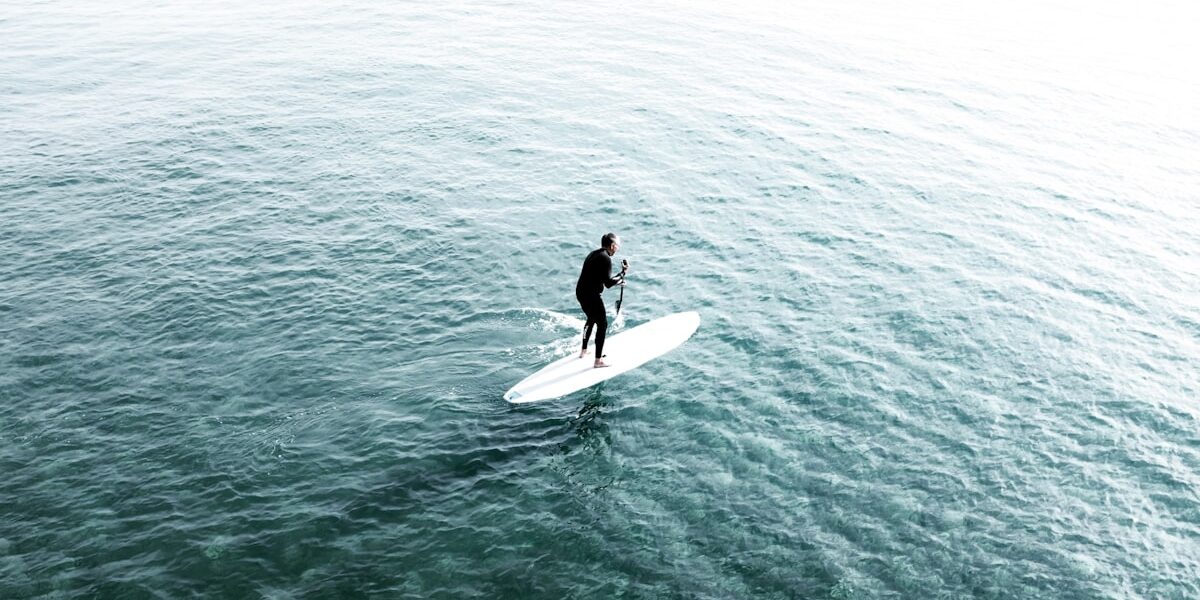
Every stand-up paddler should be able to climb back onto the board without help. A leash and life jacket can buy time, but they do not replace a practiced SUP self-rescue. Learn the sequence in warm, calm, chest-deep water with another capable person nearby before relying on it farther from shore.
SUP self-rescue: the short version
- Surface, breathe, and check for immediate hazards.
- Stay with the board; it is your largest flotation aid and is easier for rescuers to see.
- Move to the board’s side near the center carry handle.
- Lay the paddle across the deck or hold it under the hand gripping the handle.
- Kick your legs near the surface while pulling your chest across the board.
- Rotate onto your belly, then remain prone or rise to your knees.
- Account for your partner and equipment, then choose the safest route to shore.
Before you practice
Wear a properly fitted life jacket and dress for the water temperature, not just the air. Choose clear water away from docks, rocks, swimmers, boat traffic, current, breaking waves, and offshore wind. Confirm the depth before deliberately falling; never dive headfirst from a board. Tell your practice partner what you are doing and stop if cold, fatigue, pain, or panic begins to impair you.
The American Canoe Association’s paddlesports video library includes a dedicated demonstration on getting back onto a stand-up paddleboard. Its SUP safety materials also emphasize knowing how to self-rescue before a trip.
How to fall more safely
When a fall is unavoidable, try to fall away from the board and paddle rather than stepping onto the rail or grabbing at equipment. Protect your head and face with your arms as you enter. Do not assume the water is deep merely because you launched there; submerged rocks, pilings, stumps, and changing tides can make a feet-first impact dangerous too. In shallow or obstructed water, stay low and paddle on your knees instead of practicing falls.
How to remount from the side
Approach the center of the board, usually beside the carry handle. Face the deck and reach across it. Keep your body nearly horizontal: letting your legs hang straight down makes the pull much harder. Kick firmly as you pull the deck toward your chest, slide your ribs and stomach across the rail, and then roll your hips onto the board. This is a coordinated kick-and-pull, not an upper-body pull-up.
Once aboard, stay prone for a moment. Retrieve or secure the paddle, move back toward the center, and assess the conditions. If standing would risk another fall, paddle prone or kneeling toward a safe landing. Being back on the board matters more than immediately standing.
If the normal remount is difficult
- Board keeps sliding away: keep your chest close to the rail and kick before pulling. On appropriate flatwater, a suitable leash helps prevent separation.
- Board flips toward you: reach farther across the deck and pull your body over it rather than pulling the near rail downward.
- High-volume board is hard to climb: try remounting near the tail, where some boards sit lower, then crawl carefully to the center.
- Wind is pushing the board: stay attached to the flotation, get low, and avoid spending energy chasing loose gear.
- You are tiring: stop repeated attempts, float with the board and signal for assistance. A whistle, waterproof communication device, and filed float plan make this far safer.
Leashes depend on the environment
A leash is a key safety tool in many open-water and flatwater settings because wind can move a board faster than a swimmer. It can become an entanglement hazard in moving rivers, however. The ACA’s SUP leash guidance distinguishes flatwater and surf choices from moving-water systems, where any leash decision requires specialized training and an accessible quick-release setup. Do not copy an ocean or lake leash arrangement onto a flowing river.
Assisted rescue and when to call for help
If a paddler cannot remount, a trained partner may stabilize the board from the opposite side while the swimmer climbs on. Avoid standing upright or letting two people pull the same rail down. Once the person is supported, call emergency services or marine rescue when needed and follow local instructions. Do not attempt an improvised tow in conditions beyond your training.
Treat confusion, poor coordination, violent shivering, unusual fatigue, or loss of dexterity as urgent warning signs, especially in cold water. The safest response may be to remain on the board, minimize further immersion, signal visibly and audibly, and await rescue rather than attempting a long swim.
A practical self-rescue progression
- Remount once in warm, protected, chest-deep water.
- Repeat from both sides until the movement is controlled.
- Practice retaining the paddle during the remount.
- Remount while wearing the clothing and PFD used on real trips.
- Under qualified supervision, progress only to conditions appropriate for your skill.
Repeat the drill at the start of each season and whenever you change boards or equipment. Pair it with the complete SUP safety checklist so the rescue skill is supported by the right PFD, communication plan, weather decision, and environment-specific leash.



Stay in the loop
Get the latest sup spots updates delivered to your inbox.