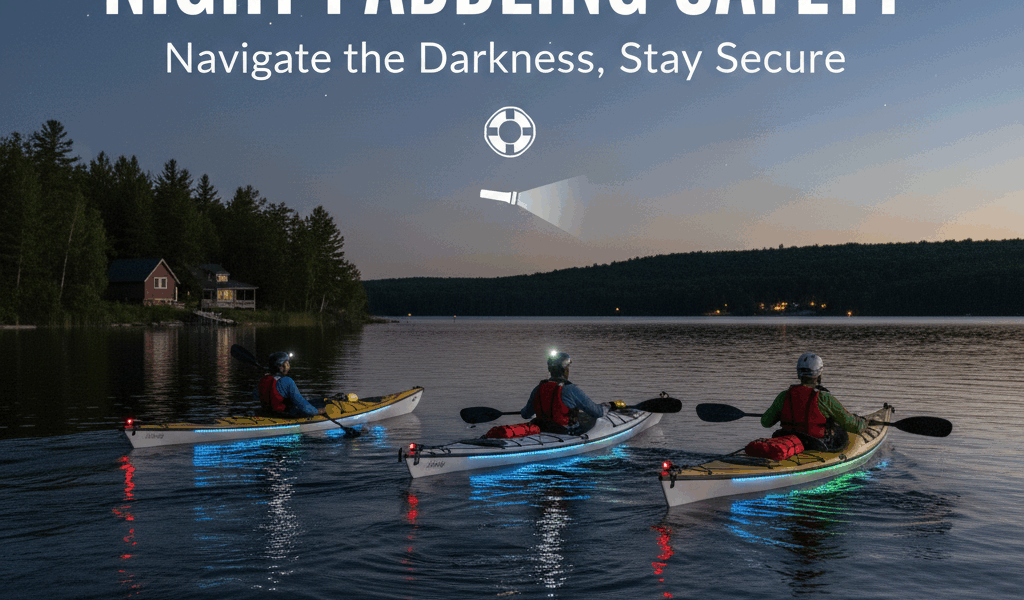
Night paddleboarding can be peaceful, but reduced visibility makes ordinary navigation, weather, cold-water, and boat-traffic mistakes harder to correct. The safest first night trip is a short, familiar, protected route with legal lighting, a capable partner, a life jacket, reliable communication, and an easy exit.
What light does a paddleboard need at night?
In the United States, a stand-up paddleboard used outside a narrow swimming, surfing, or bathing area is generally treated as a vessel. Under Navigation Rule 25, a vessel under oars may show the lights prescribed for a sailing vessel. If it does not, it must have an electric torch or lighted lantern showing a white light ready to display early enough to prevent a collision. The Coast Guard reproduces that language in its Navigation Rules guidance for vessels under oars.
That federal baseline is not permission to improvise. State, tribal, park, harbor, and local authorities may impose additional rules, and an organized event may require more. Check the controlling jurisdiction before launching. A wearable headlamp is useful for tasks but can be blocked by your body or blind another operator; carry a dedicated, waterproof white light that you can present in every direction, plus an independent backup.
Night SUP equipment checklist
- Required navigation light or immediately available white light, as applicable to the waterway
- Backup waterproof light with tested batteries
- Properly fitted, worn life jacket and an accessible whistle
- Reflective material on the PFD, paddle, clothing, or board
- Waterproof phone, VHF radio, or locator appropriate to coverage and venue
- Environment-appropriate leash; moving water requires specialized leash judgment
- Thermal protection based on water temperature
- Simple route, float plan, and agreed check-in time
The American Canoe Association’s SUP life-jacket guidance notes that paddlers outside swimming or surfing areas need a life jacket and whistle. Wearing the PFD is substantially more useful than storing it under deck rigging, especially when a dark-water fall is disorienting.
Plan the route in daylight
Paddle the route during daylight first. Mark the launch, legal landing points, shallow areas, docks, cables, rocks, pilings, low branches, boat channels, and places where shoreline lights disappear. Keep the night route shorter than your daytime ability suggests, remain close enough to a safe shore for the conditions, and set a firm turnaround time.
File a float plan with someone ashore: who is paddling, board descriptions, launch and return points, route, vehicle information, communication method, and the time to call for help. Do not depend on a phone map alone. Cold, water, battery loss, gloves, weak reception, or screen glare can make it unavailable precisely when needed.
Protect your night vision
Use the lowest light level that safely completes a task, direct beams down and away from other people, and avoid staring into bright shore lights. A red task-light mode may help preserve dark adaptation, but it does not replace the legally required collision-avoidance light. Keep the white light accessible with either hand and practice switching to the backup without opening a dry bag.
Reflective gear improves detection when another vessel’s beam reaches you, but it is not a navigation light. Decorative colored LEDs can also be mistaken for the red, green, or white lights that communicate a vessel’s direction. Do not display confusing lights; use equipment and patterns accepted for the jurisdiction.
Avoid boat traffic rather than relying on visibility
Assume a motorboat operator may not see a low-profile paddler against shore lights. Avoid marked channels, marina entrances, ferry paths, fishing traffic, and areas where fast vessels operate. Cross a channel only when necessary, at a predictable angle, after confirming ample separation. Never assume that having a light gives you right of way or guarantees detection.
Listen continuously for engines, wakes, navigation buoys, surf, wind, and voices. Travel at a speed that allows an immediate stop or kneeling transition. Keep the group compact enough to communicate without bunching boards together, and establish simple whistle or voice signals before launch.
Weather and cold are harder to judge after dark
Check the marine or local forecast, wind direction, gusts, tide or current, water temperature, thunderstorm risk, and any advisories shortly before launch. At night, visual cues for squalls, chop, fog, and offshore drift are weaker. Use a conservative no-go threshold and cancel if the return leg depends on uncertain wind or current.
Air can cool rapidly after sunset while the water remains dangerously cold in any season. Dress for immersion, not the parking-lot temperature. If fog forms, wind rises, lightning threatens, a light fails, or anyone becomes cold or disoriented, end the trip through the nearest safe, legal exit rather than pressing toward the original destination.
If someone falls or becomes separated
Call out, stop the group, illuminate the water without blinding the swimmer, and keep the board with the person. Signal boat traffic and emergency responders early. A paddler should already know how to perform a SUP self-rescue and board remount while wearing the same PFD and clothing used at night.
For a first after-dark session, go with an experienced local guide or instructor. The goal is not merely to see the shoreline—it is to remain identifiable to other vessels, navigate without losing situational awareness, and retain enough margin to handle a fall, failed light, weather change, or closed landing.

Stay in the loop
Get the latest sup spots updates delivered to your inbox.