Why This Keeps Happening to You
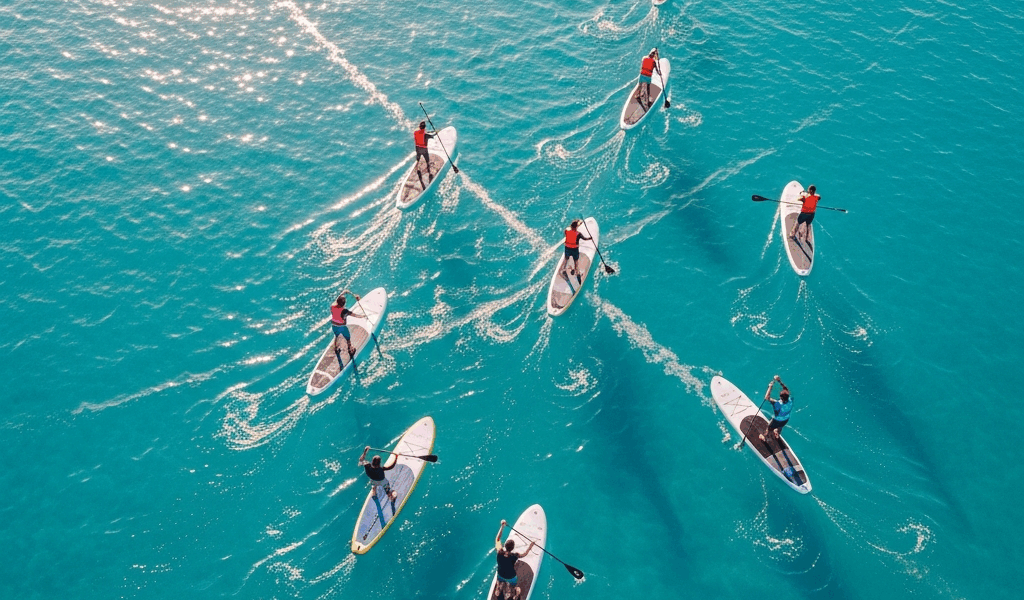
SUP paddling in crowded water has gotten complicated with all the conflicting advice flying around. As someone who nearly took out two complete strangers at Mission Bay before 9 a.m. on a Tuesday, I learned everything there is to know about what actually causes these near-misses. Today, I will share it all with you.
Here’s the thing nobody tells you upfront: it’s not crowded conditions. It’s not bad luck. It’s three mechanical mistakes you’re probably making right now — and every single one is fixable without buying a new board or finding some perfect empty cove to practice in.
- Delayed stroke correction — your forward stroke drifts you sideways without you noticing until it is too late
- Underestimating board glide — you do not account for how far your board coasts after each paddle stroke
- No emergency pivot skill — when avoidance is necessary, you cannot turn fast enough
None of this requires special conditions or expensive gear. What it requires is understanding what your body is actually doing on the water. So, without further ado, let’s dive in.
Your Strokes Are Steering You Into People
But what is an unbalanced forward stroke? In essence, it’s when your blade catches the water slightly off-center — stronger on one side than the other. But it’s much more than that. Over ten strokes, you’ve drifted a full board width sideways. Over twenty, you’re heading straight into a group of paddlers you had zero intention of approaching.
I spent an entire season thinking I was just “naturally drifty.” Turns out I was taking six strokes on my right side before switching. Six. My right side was consistently stronger, pushing me left the whole time. Don’t make my mistake.
The fix is a corrective sweep stroke initiated early — at least if you want to avoid that last-second panic correction that never actually works. Here’s the diagnostic drill: pick a distant landmark, a pier post, anything fixed. Paddle toward it for thirty forward strokes. Don’t correct. Just observe. More than one board width off target? Your forward stroke is steering you into trouble.
Now paddle back using a corrective sweep every four or five forward strokes. On your weaker side, plant your blade near the nose and arc it toward the tail. Simple. It kills the drift before other paddlers even notice it happening. That’s what makes early correction endearing to us crowded-water paddlers — it’s invisible, quiet, and keeps everyone safe without drama.
Practice this in open water first. Not in the crowded zone. The muscle confidence you build from smooth, early correction is exactly what stops you from panic-steering into someone’s rental kayak.
You Are Not Accounting for Board Glide
Probably should have opened with this section, honestly.
A typical SUP board keeps moving fifteen to thirty feet after your last paddle stroke. Thirty feet. Most paddlers feel themselves slowing and assume they’re stopping. They’re not stopping.
I discovered this the hard way after nearly T-boning a woman doing a full sun salutation in flat water at Aquatic Park. I was convinced I was stopped. I was absolutely still moving. She saw me coming and got out of the way — but that moment stuck with me for weeks.
The variables matter here. An eleven-foot board holds momentum longer than a nine-footer. I’m apparently 215 pounds and my 11’6″ Thurso Waterwalker works against me in close quarters, while my friend’s shorter 9’6″ board never carries nearly as far. Board length, paddler weight, water chop — all of it compounds the glide distance in ways that feel counterintuitive until you’ve actually measured yours.
Do this drill: grab a floating water bottle or find a buoy. Paddle toward it at your normal cruising speed, then stop paddling completely. Don’t drag your blade. Don’t pivot. Just coast and watch. Do it ten times. You’ll calibrate your actual stopping distance fast — not an imagined one, but the real number your specific body and board create together.
Now you know. In crowded water, you stop paddling earlier. You build in more buffer zone. You stop being surprised by where you end up.
How to Pivot Fast When You Need To
The step-back pivot is the emergency skill that separates paddlers who avoid collisions from paddlers who cause them. Most beginners never practice it until they desperately need it. That is too late — at least if you care about not ruining someone else’s Saturday morning paddle.
Here is the step-by-step breakdown:
- Shift your weight toward the tail of the board. Lift the nose slightly out of the water.
- Plant your paddle blade on the side you want to turn toward — if you want to turn right, plant on the right.
- Push the blade forward and outward in a sweep motion. Your board spins around the tail.
- Once you have cleared the obstacle or paddler, resume forward paddling.
Two to three seconds in flat water. That’s the whole maneuver. The critical detail is that you’re pivoting around the tail — not around your body. Frustrated by how slow a standard sweep turn felt in tight spaces, I started experimenting with tail-weighted pivots during a solo session at Lake Merritt and eventually landed on this technique. This new approach took off several years later and eventually evolved into the emergency pivot drill enthusiasts know and rely on today.
Set up fifteen feet from a floating object. Paddle toward it, execute the step-back pivot at the last safe moment, repeat five times. Your body will remember the weight shift and blade position. When a real collision risk appears, your muscle memory handles it instead of your panicking brain.
Practice Drills That Build Crowd Awareness Fast
While you won’t need a professional coaching session or a private lagoon, you will need a handful of floating objects, a friend on occasion, and about ten minutes per week.
Slalom drill: Place four or five water bottles or small buoys in a line, spaced roughly thirty feet apart. Weave through them, focusing on corrective sweep strokes — not over-corrections. First, you should do this slowly — at least if you want to actually train the muscle memory rather than just flail through the course. This one sharpens directional awareness faster than almost anything else.
Buddy shadowing: Paddle behind a friend at close range. Match their speed, match their adjustments. When they shift, you shift. This trains your eyes to read movement patterns in ways that solo paddling simply never does.
Stop-on-a-dime distance practice: Mark two points roughly fifty yards apart. Paddle between them at different speeds and stop as close to your target as possible without touching it. Do it at half-speed, then three-quarter speed, then full pace. The glide calibration you build here is specific to your board and your weight — nobody else’s numbers apply.
Run each drill five to ten minutes once a week. Two or three sessions in, you’ll notice the difference. Your spatial awareness sharpens. Your emergency responses shift from reactive to automatic. That’s what happens when the skill catches up with the environment — and that’s exactly what crowded water demands from you now.

Stay in the loop
Get the latest sup spots updates delivered to your inbox.