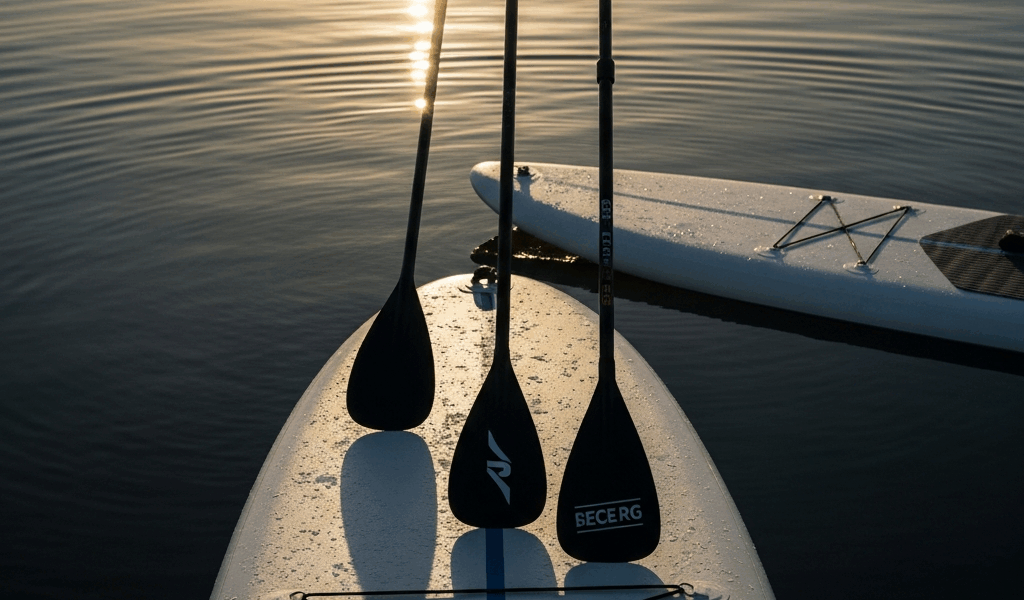
How a Wrong Paddle Length Actually Feels on the Water
SUP paddle sizing has gotten complicated with all the conflicting advice flying around. As someone who spent two full seasons blaming my technique for everything that felt off, I learned everything there is to know about what a mismatched paddle actually does to your body. Today, I will share it all with you.
The short version: your body was telling me the whole time. I just wasn’t listening to the right signals.
A paddle that’s too long does something very specific. It forces your shoulders up toward your ears the moment you hit the catch — your top hand climbs too high, and what should be a powerful pull becomes a chopping motion. All shoulder. Zero leverage. By mile two, your rotator cuff is on fire. You’re working twice as hard and going the same speed. Worse, you start hunching over the board without realizing it, which wrecks your balance and turns every small chop into a negotiation. By day’s end, your neck feels like it lost an argument.
A paddle that’s too short creates its own misery — different, but equally exhausting. You’re reaching down and forward at this awkward angle just to get the blade wet. Your stroke dies somewhere around your hip instead of carrying through to your ankle, which guts your power zone entirely. You torque your torso harder to compensate, which feels unstable even on flat water. In any real chop, it becomes genuinely tiring. Your arms quit early because your back muscles never got invited to the party.
The worst part is the mental side of it. You start thinking you’re losing fitness. You wonder whether SUP is even right for you. Then you borrow a friend’s paddle — maybe a Werner Camano, maybe just some adjustable rental — and suddenly everything clicks. That’s not you improving. That’s geometry.
The Basic Starting Formula and Why It Often Fails
The formula everyone finds first: stand the paddle next to you on flat ground. Your wrist should fall somewhere between your wrist crease and the top of your head when your arm is raised overhead. The older version — board thickness plus 8 to 10 inches — still floats around too. Ten-inch-thick board means a 28-to-30-inch shaft. Fine. Workable. Until it isn’t.
Board width changes everything, and nobody leads with that.
A 28-inch-wide board versus a 32-inch-wide board sounds like a minor difference. It isn’t. That extra 4 inches of width raises the rail position in the water. You need more reach to hit the same catch angle. A paddle that fit perfectly on your narrower board will feel short on the wider one — same formula, wrong result.
Paddling style matters just as much. Touring flatwater for hours? You probably want something 3 to 4 inches above whatever the formula spits out, because efficiency compounds over distance. SUP surfing? Go shorter — sometimes 2 to 3 inches below formula — because quick, vertical strokes matter more than reach. Yoga paddling? Honestly, the formula barely applies. Comfort and stability win every time over efficiency metrics.
Probably should have opened with this section, honestly. Most people don’t know these variables exist until they’ve already bought the wrong thing.
There’s also the torso-versus-height mismatch that nobody talks about. Two paddlers standing at 5’10” — one long-torsoed, one long-legged — will need meaningfully different shaft lengths. The formula sees the same number. Your body disagrees.
Standard advice works as a starting point. It’s not wrong. Just incomplete.
How to Self-Check Your Paddle Length Right Now
This is the test that actually matters. Flat water, 10 minutes, done.
- Find your catch position. Stand upright, core engaged, normal paddling posture. Drive the blade into the water in front of you. Right at that moment — where is your top hand? Forehead height is the target. Maybe slightly higher. Not overhead. Not chest-level. Forehead. If it’s way off, that’s your answer.
- Check blade submersion. The entire blade should go under without your shoulders hunching or your spine twisting to get there. Scrunching up to submerge it means too long. Reaching awkwardly down means too short.
- Feel the pull phase. As you draw back, your arm straightens gradually — you’re engaging your lats and rotating your core, not yanking with your arms. Strong, stable, connected. If you’re fighting the paddle through the stroke, something’s wrong.
- Watch the exit. Blade leaves the water near your ankle. Not your hip. Not your toe. Ankle. That’s where your actual power zone ends. Still pulling at hip height? Something is off with the length or your timing.
- Monitor your shoulders. After 10 minutes of steady paddling, how do they feel? Working the right muscles, or quietly miserable? Trust that feeling — I’m apparently more shoulder-dominant than most paddlers and a slightly shorter shaft works for me while the standard formula never quite did.
Don’t make my mistake — skipping this test and defaulting to whatever measurement chart came with the paddle. A paddle that measures right but feels wrong at the catch is genuinely wrong for your body and your board. Adjust, get back on the water, test again.
Adjusting for What You Are Actually Doing That Day
Here’s the real problem most paddlers never consider: we own one paddle and take it everywhere. That’s the setup for constant low-grade frustration.
Flatwater touring is where a longer paddle earns its keep. You’re covering distance — maybe 6, 8, 10 miles — and you’re not pivoting or surfing anything. Maximum reach, maximum efficiency. If touring is your thing, aim for 2 to 3 inches longer than your casual recreational baseline.
SUP surfing demands something shorter. Full stop. You’re pivoting constantly, matching wave rhythm with quick high strokes, repositioning every few seconds. The same paddle that crushes a 6-mile flatwater session feels clumsy and slow in a wave lineup. That’s what makes versatility so elusive for SUP enthusiasts — the geometry that works beautifully in one context actively fights you in another.
Slow recreational paddling or yoga on the water? Prioritize comfort and confidence over efficiency numbers. If you feel rushed or wobbly, shortening by an inch or two often helps more than any technique adjustment.
One fixed-length paddle cannot actually serve all three of those activities well. This is why plenty of paddlers feel perpetually off — same paddle, different jobs, wondering why nothing fits perfectly.
When to Buy an Adjustable Paddle Instead of Sizing Up or Down
But what is the adjustable paddle actually worth? In essence, it’s a shaft with a locking collar that lets you dial between roughly 68 and 86 inches depending on the model. But it’s much more than that — it’s the difference between buying three paddles and buying one.
The honest trade-off: adjustable paddles cost more upfront. You’re looking at $200 to $400 for a decent model — something like the Werner Skagit or the Aqua-Bound Sting Ray — versus $150 to $250 for a good fixed-length carbon or fiberglass shaft. The locking mechanisms on cheaper adjustables can slip mid-paddle, which is genuinely annoying. Mid-tier and up, that problem mostly disappears.
Buy adjustable if: you share a board with someone meaningfully taller or shorter than you. You do multiple activity types. You travel and rent different boards that vary in thickness and width. You’re still in the figuring-it-out phase.
Fixed-length makes sense if: you own one board, paddle the same style consistently, and already know what length works. Fewer moving parts. Slightly better feel in the shaft for some paddlers.
If you’re mid-season and quietly frustrated every time you paddle, an adjustable solves the “something feels wrong and I can’t name it” problem faster than anything else. Dial it up 2 inches, go paddle. Dial it down, go paddle again. You’ll find the number without buying multiple shafts.
Your paddle length should eventually disappear from your awareness entirely. You should be thinking about the water, the rhythm, the horizon — not quietly managing your shoulder position every stroke. The self-check test takes 10 minutes on flat water. That’s it. Do it, adjust, do it again. That small act of attention fixes what the formula missed — and probably saves your rotator cuff in the process.
Start with the SUP paddle sizing and on-water adjustment process, then use this troubleshooting guide when posture, plant, or exit still feels wrong.

Stay in the loop
Get the latest sup spots updates delivered to your inbox.