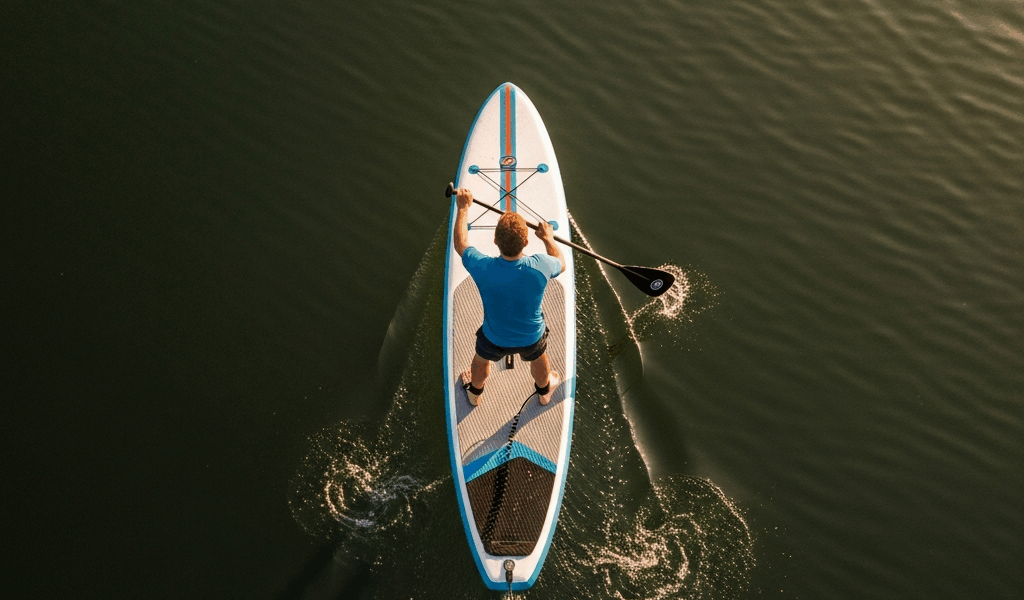
The Stroke Is Only Half the Problem
SUP speed has gotten complicated with all the gear advice and stroke tutorials flying around. As someone who spent two full seasons convinced my equipment was the problem, I learned everything there is to know about what actually kills your momentum on flat water. Today, I will share it all with you.
That silent moment between strokes — when your board just bleeds speed for no obvious reason — drove me insane for longer than I’d like to admit. I blamed my Naish paddle. Then my hull. Then the wind. Turns out the real failure lived in four connected places I wasn’t even watching: blade exit timing, weight distribution, volume mismatch, and body position. Most paddlers obsess over stroke power and ignore everything else. That’s backwards, honestly.
The good news? You can diagnose exactly where things are breaking down without dropping $800 on new gear. You just need to know what you’re looking for. So, without further ado, let’s dive in.
You’re Pulling the Blade Too Far Back
Probably should have opened with this section, honestly. This is where most paddlers hemorrhage speed without ever realizing it.
When your blade passes your hip and keeps traveling — dragging toward your ankle — you stop moving the board forward. You start braking it. Think about pushing a shopping cart from behind versus pulling it from the front. One accelerates the load. The other fights it. Blade past the hip is the pull-from-the-front scenario. It’s slow. Really slow.
But what is the correct exit point? In essence, it’s your hip. But it’s much more than that — it’s the exact moment your blade stops creating forward thrust and starts pushing water sideways and upward, which means every inch past that line is working against you instead of for you.
I tested this on a flat stretch of the Intracoastal near Fort Lauderdale with a GoPro zip-tied to the bow of my 10’6″ Naish One, shooting my feet from above. I could literally see the blade dragging 12 extra inches past my hip on every single stroke. Over a 30-minute session — maybe 800 strokes — that compounds into serious, measurable speed loss. Don’t make my mistake.
The fix isn’t complicated. Shorten your reach slightly. Rotate your shoulders more aggressively at the catch. The blade should exit before your hips even finish rotating forward. It feels wrong at first — your instincts scream “more power, longer pull.” Wrong. Power comes from cleaner mechanics and higher cadence, not extra blade travel.
Your Stance Is Creating Drag You Can’t See
Move your feet three or four inches too far back and the tail sinks. The nose lifts. Your hull stops planing and starts bulldozing water. You won’t feel it happen. You’ll just feel inexplicably slower lap after lap.
For flat-water cruising, centered or slightly forward of center is where you want to live. Weight over the balance point. Nose and tail sitting at roughly equal height. That’s what makes proper SUP stance endearing to us paddlers — it’s invisible when it’s right and obvious when it’s wrong, once you know what to look for.
Here’s a dead-simple on-water diagnosis: paddle at comfortable cruising speed and look down at your nose. Air under the front third? You’re too far back. Spray pushing off the bow? Too far forward. The sweet spot is maybe a quarter-inch of daylight between the nose and the waterline. Flat. Neutral. Almost boring-looking — which is exactly the point.
I’ve run this test on three boards: a 10’0″ Bark Commander touring board, a 12’6″ racer, and an 11’6″ Starboard all-rounder. Moving my stance back four inches on each one killed the glide noticeably. Moving forward two inches brought it back. The difference between a board that coasts 50 feet after your last stroke and one that quits at 35 feet is often just foot position. Your body is the ballast — use it deliberately.
Your Board Volume May Be Working Against You
A board with too much volume for your weight rides high. Wobbles. Fights every stroke. That’s what makes volume mismatch so frustrating to diagnose — it doesn’t feel like a volume problem. It feels like instability, like wind, like bad water conditions.
But what is volume mismatch, exactly? In essence, it’s your hull sitting too far above the waterline to engage properly. But it’s much more than that — a hull shape that can’t settle into the water can’t track straight, and a board that can’t track straight bleeds speed sideways on every stroke.
I’m apparently a pretty textbook 185 pounds and the Starboard All Star 11’6″ — recommended range 90 to 220 pounds — works for me while shorter high-volume boards never tracked right. Tried a 9’6″ board designed for lighter paddlers once. Spent 45 minutes feeling like I was paddling a cork. That was 2021. Never again.
Check your board’s recommended weight range — it’s either in the manufacturer specs or stamped somewhere on the deck. If you’re sitting 20 or more pounds above or below that range, volume is probably dragging down your whole system. If you’re squarely in the middle, volume isn’t your problem. Which means the culprit is blade exit or stance. Start there.
How to Test Whether You’ve Fixed It
You don’t need fancy equipment. Use what you have.
Find a flat-water stretch with two visible landmarks — two docks, two buoys, two trees — roughly 100 yards apart. Paddle hard for one minute between them. Count your strokes. Write the number down on your phone. Rest two minutes.
Now apply one fix. Shorten your blade exit to your hip. Run the same section at the same perceived effort. Count again. Same distance, fewer strokes — that’s measurable efficiency gain. That’s real.
Next session, shift your stance forward two inches. Run the same drill. You’re building a feedback loop — your body learning what efficient movement actually feels like, not just what it looks like in a YouTube tutorial.
While you won’t need a GPS watch or a coach, you will need a handful of sessions to isolate each variable properly. First, you should fix blade exit — at least if you want an honest baseline. Volume mismatch might be the best thing to address second, as flat-water efficiency requires hull engagement. That is because no amount of technique fixes a mismatched board underneath you.
The glide phase is your real metric. A board coasting 40 feet after your last stroke beats one that quits at 25 feet — regardless of how hard you paddled. Speed loss lives in that glide. Fix the four systems, and that coasting distance extends in ways you’ll feel immediately. You’re not imagining the problem. It’s real, it’s diagnosable, and it has nothing to do with buying a better paddle.


Stay in the loop
Get the latest sup spots updates delivered to your inbox.