How to Stand Up on a SUP Board for the First Time
Standing up on a SUP board has gotten complicated with all the conflicting advice flying around. “Just stand up.” “Trust your balance.” “It’s easier than it looks.” None of that helps you when you’re out there on actual water, knees trembling, board rolling beneath you like a wet log. As someone who has watched hundreds of beginners attempt their first stand — and face-planted spectacularly during my own — I learned everything there is to know about what actually separates a successful first session from a humiliating one. Today, I will share it all with you.
Most beginner guides tell you to stand up on a paddleboard the way a recipe tells you to “bake until golden.” Technically accurate. Completely useless. This is different. Every step here anticipates where you’ll fail and walks you through the fix before it happens.
Start on Your Knees, Not Your Feet
But what is the kneeling phase, really? In essence, it’s a calibration period. But it’s much more than that — it’s the entire reason some people stand up on their first try while others spend an hour falling sideways into cold water.
Skipping the kneeling phase is the single most common beginner mistake. Don’t make my mistake. Kneeling first drops your center of gravity dramatically, which makes even a budget 10’6″ all-around board feel nearly immovable. You’re also closer to the water surface — maybe 18 inches instead of five feet — so falling stops feeling catastrophic. That mental shift matters more than most people admit.
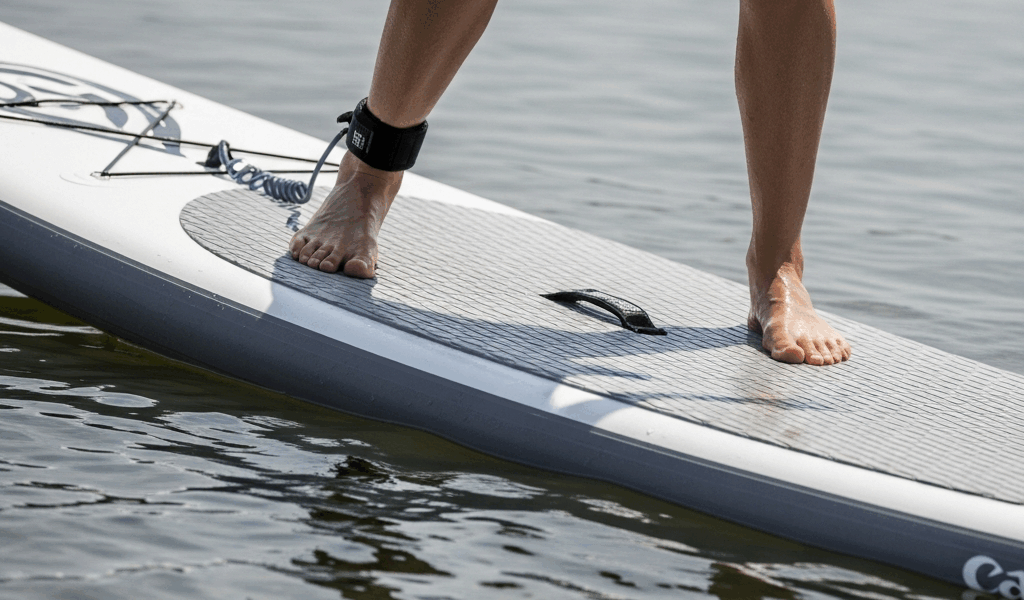
Here’s the specific technique. Wade your board into shallow water — knee-deep minimum, waist-deep if you can manage it. Place both hands flat on either side of the deck, then pull yourself up into a kneeling position. Your knees should land roughly centered over the carry handle. Not crowded toward the nose. Not crept back toward the tail. Both of those kill your stability immediately, and beginners do both constantly.
Stay kneeling for two to three full minutes. I know that sounds excessive. Do it anyway. Shift your hips left, then right. Feel how far the board actually tilts before it becomes a problem — probably farther than you expected. That sensory data is what your nervous system needs before it will let you stand with any confidence. You cannot rush this part and expect different results.
How to Actually Get to Your Feet Without Falling
Once the board feels manageable beneath your knees, it’s time to stand. The sequence matters. A lot.
Lay your paddle flat across the deck in front of you — not to lean on heavily, just for a fingertip reference point if you need a fraction of extra balance. Plant one foot forward, directly under your shoulder. Then bring the other foot up beside it, feet roughly shoulder-width apart, positioned somewhere between the carry handle and your former kneeling spot. Feet parallel. Not splayed out like a duck. Parallel.
Here comes the part that wrecks most people: keep your eyes forward. Look at the shoreline or the horizon — something roughly level and distant. Not at your feet. Not at the board surface. Every single person who falls during this transition looks down first, which tilts the head forward, which shifts weight unconsciously toward the nose, which submarines them face-first into the water. I learned this the hard way. Twice. In front of people.
Rise slowly. Straighten your legs gradually so your body has actual time to adjust. The whole transition from knees to standing should take somewhere between five and ten seconds — not a frantic lurch upward. Once you’re fully upright, then grab the paddle properly. Not before.
Why You Keep Falling and How to Fix It
If you’ve already tried this and it went badly, one of three things happened. Let’s diagnose.
Issue one: standing too far back on the tail. The rear third of the board feels intuitively safer — less tippy, more solid. It’s actually the worst position. Standing on the tail lifts the nose, kills responsiveness, and makes controlling the board almost impossible. Fix: keep your feet directly over the board’s midpoint or just slightly forward of it. The carry handle is your landmark — stand near it.
Issue two: locking your knees. Panic triggers stiffness. Stiffness removes all the natural shock absorption your leg muscles provide. The board moves, you have zero flexibility to compensate, and down you go. Fix: maintain a slight, constant bend — think a skier’s stance, or the way a shortstop stands before a pitch. Legs ready to move, never rigid.
Issue three: overcorrecting every wobble. The board shifts two inches. You throw your shoulders sideways to compensate. The board shifts four inches in the other direction. You’re now fighting it instead of riding it, and the wobble amplifies until you’re swimming. Small corrections live in your ankles and hips. Fix: when the board moves, stay soft and make tiny adjustments low — not dramatic upper-body swings that create more instability than they solve.
Where to Practice for the Best Chance of Success
Location matters more than most instructors admit. Flat, calm water isn’t a luxury preference — it’s a mechanical requirement when you’re learning basic standing mechanics.
Start somewhere genuinely calm. A protected bay. A lake on a windless morning — ideally before 9 a.m. when thermals haven’t kicked up yet. A pool, if you happen to have access to one that’s deep enough. Chop and small waves introduce variables your nervous system isn’t ready to process. The board moves unpredictably, punishes poor balance before you’ve built any muscle memory, and generally teaches you nothing except that this is harder than it looked on YouTube.
Shallow water matters equally. Waist-deep is ideal. Chest-deep still works. Falling in shallow water feels like part of the process — a minor annoyance, a wet reset. Falling in deep water triggers survival instincts that make you tense, and tension is the enemy of everything described in this guide.
Watch the wind. Offshore wind — blowing away from shore — can push a beginner paddler out surprisingly fast. On-shore wind is safer directionally but often chops up the surface. Aim for conditions under five knots. Not sure how to gauge that? Look at the water texture. Glass-smooth is what you want. Any visible rippling means conditions are already more than your first session needs to deal with.
Once You Are Standing, Here Is What to Focus On
Probably should have opened with this section, honestly. Most guides bury it at the end as an afterthought, but this is where the actual paddling begins.
A stable standing position feels like this: soft knees, weight centered over the balls of your feet rather than your heels, shoulders relaxed and not hunched up around your ears, paddle held roughly horizontal across your body at about chest height. Head up, eyes forward. Core engaged — not clenched, just present. You’re actively maintaining balance, not white-knuckling the paddle like it might save you.
I’m apparently someone who stands with weight slightly toward my front foot, and that works for me while a neutral centered stance never quite clicked. You’ll find your own version. The point is to experiment from a place of stability rather than barely-controlled falling.
That’s what makes SUP endearing to us beginners — the learning curve is brutally steep on day one and then almost immediately flattens out. Your first session might end with five sustained seconds of standing. That counts. Your second session might include ten seconds plus three actual forward strokes. That also counts. Once your body has stood up on a board even once, it has the reference point it needs to build from. The biggest gap is the one you just crossed.
Before practicing the first stand, use the SUP weather go/no-go checklist and the life jacket, leash, and rescue-plan guide.

Stay in the loop
Get the latest sup spots updates delivered to your inbox.