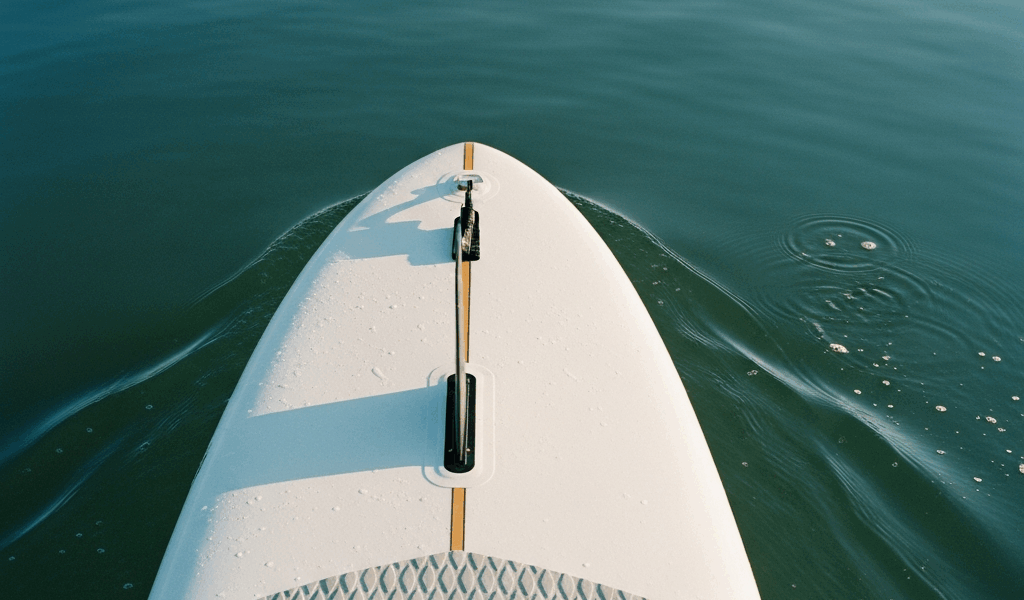
The Most Common Reason Your Board Pulls to One Side
SUP tracking has gotten complicated with all the conflicting advice flying around. Everyone blames their stroke. Almost nobody checks the obvious thing first.
Your fin.
As someone who spent three humbling weeks convinced my paddle technique was broken, I learned everything there is to know about directional drift the hard way. My fin box had shifted a quarter inch during a car ride to the beach. That was it. Three weeks of frustration over a quarter inch.
Today, I will share it all with you.
A fin that’s even slightly off-center will pull your board the same direction on every single stroke. You fight it. You adjust. You fight it again. You never win because you’re fixing the wrong thing.
Here’s what to check first — before you touch anything else. Pull the board up to eye level and sight down the centerline from nose to tail. Your fin should run dead center inside that box. If it’s favoring one edge even slightly, you’ve found your culprit. Took me about eight seconds to spot mine once I actually looked.
Next, grab the fin and wiggle it side to side. Loose fin boxes are almost as common as misalignment. Most modern boards run a US Box or Universal fit — these need to be genuinely snug. Feel any play at all? Tighten the fin screw by hand. A fin moving more than a millimeter is working against you on every stroke, all session long.
Also confirm the fin is seated completely into the box. Sounds obvious. I’ve watched paddlers launch with fins that were almost — but not quite — fully seated. The back edge sits a hair proud. The fin rocks under load. The board drifts for hours and nobody understands why. Don’t make my mistake.
Do this check right now if you’ve been fighting drift. Nine times out of ten, this fixes it on the spot.
How Your Paddle Stroke Is Making It Worse
Assuming your fin is square and seated, your stroke is probably asymmetrical. Most online advice stops here — “just paddle straighter” — which is honestly useless.
Here’s what’s actually happening. Right-handed paddlers almost universally lean harder into their right side without realizing it. The right stroke goes deeper, hits harder, or both. The left stroke is basically a recovery — rushed, shallow, almost an afterthought. Over fifty strokes a minute, that imbalance stacks fast. The board curves left. Every time.
Blade angle is the other culprit. If your blade exits the water angled inward on one side, you’re pushing the nose away on that stroke. Same directional pull, different cause.
Test this while stationary. Ten strokes on the right side only — where does the nose go? Then ten on the left. The side that pulls the nose harder is the side you’re overloading. Simple diagnostic. Takes maybe ninety seconds.
The fix isn’t “paddle with better form.” That’s vague and it doesn’t work. The fix is switching sides more frequently. If your right side dominates, go five strokes right, five left, repeat the whole session. Neither side gets a chance to take over. The board stops fighting you.
The J-stroke — rotating the blade outward at the end of the stroke — handles minor corrections well. It is not a fix for a systematic imbalance problem. Use it to nudge the board back on line, not as a crutch for lopsided paddling.
Wind and Current Are Steering Your Board Too
Probably should have opened with this section, honestly.
Wind and current drift looks exactly like a board problem or a technique problem. You’re convinced the board is pulling left. What’s actually happening is a crosswind pushing you right, and your body is compensating without your brain registering any of it.
Test this in under a minute. Stop paddling. Let the board coast completely. Which way does it drift? That’s wind or current — not your stroke, not your fin, not your stance. Your board is fine. The environment is steering you.
On glassy days, you notice nothing. On days with even a 10-knot wind, a lightweight carbon board — something in the 22-24 pound range — gets pushed laterally more than most people expect. It becomes the dominant factor in directional control, and people spend sessions fighting it without ever identifying it.
Compensation is straightforward. Angle your body slightly into the wind so the board cocks a few degrees against it. Shift your paddle strokes toward the downwind side more often — wind pushing you right means paddle your left side more frequently. This isn’t a correction you make mid-stroke. It’s your setup from the start. You’re working with the environment instead of against it.
River paddlers and anyone in a tidal bay deal with the same thing from current. The water moves. Your board moves with it. The paddlers who look effortlessly smooth aren’t paddling harder — they’re paddling smarter, with adjustments dialed in before the drift even starts.
Check Your Stance and Weight Distribution
This one is underdiagnosed. Especially on race boards and narrower touring shapes.
Stand too far toward the left rail and your board edges and carves left. Stand too far right and it goes right. Constantly. All session.
On a 28-inch-wide beginner board, weight distribution is forgiving enough that most people never notice. On a 26-inch race board — or anything under 27 inches — it’s everything. Two inches off-center and the board wants to turn that direction all day long. I’m apparently built to stand left of center naturally, and my old Starboard Touring punished me for it every single time until I figured out what was happening.
Find neutral stance by standing mid-board, feet roughly shoulder-width apart, weight distributed equally across both feet. Most boards have a center diamond or line for exactly this reason. Stand on it. Neither rail should dig more than the other.
If the board still pulls slightly, shift one foot an inch toward the centerline. Most paddlers find their optimal stance sits a few inches narrower than their natural default. This isn’t about narrowing your base for balance — it’s about centering your mass over the board’s spine.
Fore-aft foot position matters just as much. Both feet too far forward and you’re pressing the nose down — the tail swings out. Both feet too far back and the opposite happens. Feet should sit roughly under your center of gravity, slightly forward of the board’s midpoint. Never at the extremes.
Quick On-Water Fix Checklist
- Sight down your board centerline. Check that your fin is centered in the box with zero side-to-side wiggle. Tighten the fin screw if needed. Confirm the fin is fully seated — no proud back edge, no rocking under load.
- Stop paddling and let the board coast. Drifts left or right? That’s wind or current doing the work. Angle your body into the drift and shift your paddle side toward the downwind edge more often.
- Take five strokes on your dominant side only. Does the nose pull hard? Switch sides more often during normal paddling — five right, five left, repeat. Equal sides, every session.
- Check your stance. Stand on the board’s centerline with feet shoulder-width apart. Shift weight inward an inch or two if the board still pulls. Confirm feet sit roughly under your center of gravity, not pushed toward the nose or tail.
Run through this once and you’ll find the problem. Most boards don’t drift on their own — something in your setup or your environment is pushing them. Fix the thing that’s actually broken, not the thing you think is broken.


Stay in the loop
Get the latest sup spots updates delivered to your inbox.