“`html
How to Stop Your SUP Board Nosediving in Choppy Water
I spent my first two seasons convinced my SUP board was the problem. Every time I paddled out in chop—even modest 2-foot wind waves—the nose would just… dive. Like I’d somehow forgotten how to balance overnight. Spent nearly $900 on a new board before realizing the issue was entirely between the board and me. How to stop your SUP board nosediving in choppy water comes down to three interconnected factors: where your weight actually sits, how you’re stroking, and whether your board’s geometry even belongs in choppy conditions.
Most paddlers blame the conditions or the board. Both are wrong more often than you’d think.
Why Your SUP Nose Dives in Chop
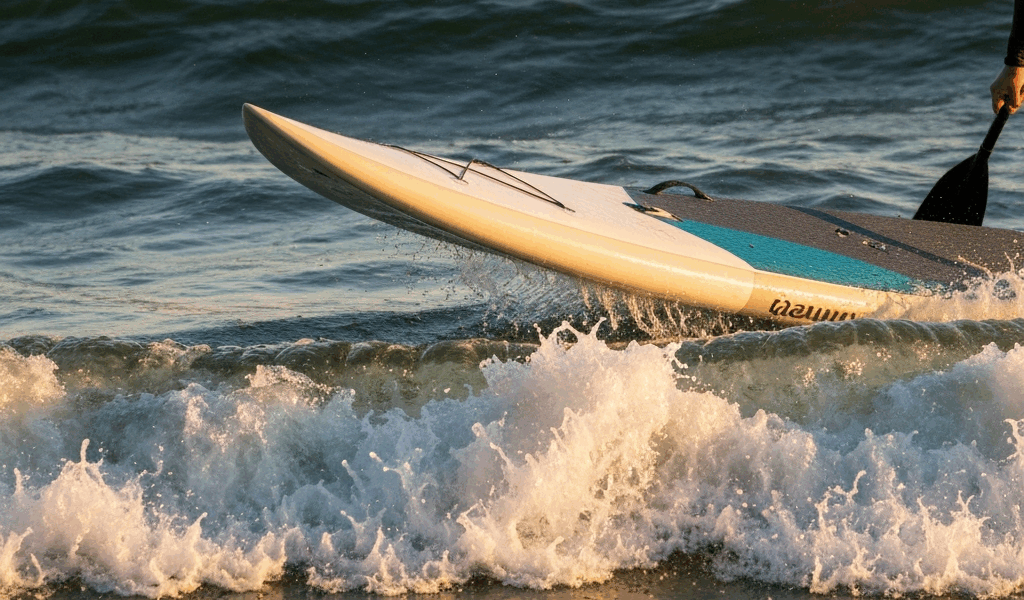
Nosediving happens when your board’s nose pushes down into the water instead of rising over an incoming wave or chop texture. Think about it mechanically for a second: you’ve got a floating platform, moving forward, meeting resistance from water.
Three things cause this to happen.
First, weight distribution. If your center of gravity sits too far forward—even by 6-8 inches—the nose gets weighted down and loses flotation where it matters most. The board becomes a seesaw with the heavy end dipping into waves.
Second, paddle technique. The way you enter the blade and the direction of your force (forward vs. downward) actually affects the board’s pitch. I learned this the hard way after watching videos of experienced paddlers: they don’t just pull backward, they pull with a specific angle that keeps the board level.
Third, board design. A board with aggressive rocker (curved bottom profile) and thin, pointy nose will nosedive easier than a flatter board with blunt nose design. Some boards are built for flat water. Some are built for chop. Most recreational paddlers own the former and encounter conditions of the latter.
The good news? The first two you can fix today. The third determines whether you need to invest in better gear or just get better at managing what you own.
Check Your Weight Position First
Probably should have opened with this section, honestly. This is the fastest fix and the one that catches most people.
Stand on your board in flat water—like you’re at your local lake on a calm morning. Mark where your feet actually sit relative to the board’s midline. Most nosedivers stand with their front foot roughly 12-18 inches forward of center. For reference, on a standard 10’6″ all-around board, the center point is roughly 63 inches from the nose. You should be standing maybe 48-52 inches from the nose. That’s three feet or more behind where most people position themselves.
Here’s how to find your actual sweet spot:
- Paddle in flat water. Feel where the board sits most stable with minimal effort to maintain balance.
- Have someone photograph your stance from the side, or film yourself paddling out. Look at where your feet land relative to the widest part of the board.
- Once you identify that balanced position, mark it. Use a waterproof marker and draw a small line across the deck. Now you have a visual reference.
The common mistake is thinking you need to move forward to see better or feel more engaged. That’s backward logic in choppy water. Moving forward trades stability for visibility. In chop, stability wins. Your peripherals and a quick glance are enough.
Test this yourself: Position your feet 6 inches further back than feels natural. Paddle into small chop. The board should feel more responsive, not sluggish. The nose should rise over bumps instead of plowing through. If it doesn’t improve, move to the next section—your paddle technique might be the culprit.
Adjust Your Paddle Stroke Technique
Influenced by years of flatwater paddling, most recreational paddlers pull the blade almost straight back with downward pressure mixed in. That downward component is your nemesis in choppy water.
In chop, your stroke needs a slight forward angle at catch and a more horizontal pull. Imagine pulling the blade through the water on a plane that’s nearly level—not pressing down hard, but driving forward. This keeps the board’s pitch neutral instead of pressing the nose down with each stroke.
Three specific mechanical changes:
- Blade entry angle: Enter the blade closer to vertical rather than leaning forward with your whole upper body. Your torso should rotate, but your shoulders stay relatively square.
- Blade depth: Push the blade deeper than you think you need—this actually reduces the downward vector. A shallow blade forces more downward pressure to grab water.
- Pull direction: Drive the blade straight back along the side of the board, not angled down-and-back. Feel like you’re pulling past your hip, not digging a hole under your feet.
Two drills to practice in flat water first:
Drill 1: The Level-Pull drill (5 minutes). Paddle normally but focus on keeping your blade at consistent depth for the entire stroke. Don’t let it rise as you finish. Maintain that horizontal pressure. This trains your muscle memory for the proper angle without fighting choppy conditions while learning.
Drill 2: The Single-Arm drill (3 minutes per side). Paddle with just your left arm for 20-30 strokes, then switch. Isolating one side forces you to feel the actual mechanics. You’ll notice immediately if you’re pressing down—the board will rotate or pitch. That feedback is invaluable.
Board Design Red Flags to Know
Not every board should be paddled in choppy water. Some are genuinely wrong for those conditions.
Check your board’s rocker profile. If it has aggressive rocker—that curved line from nose to tail that you see from the side—the nose is designed to lift high and quickly. Great for turning and cruising flat water. Bad for stability in chop, because that same curved nose wants to swing down between waves. A board with less rocker (more volume distributed toward the nose) stays flatter and more forgiving in chop.
Check your nose shape. A pointy, narrow nose is fast and responsive but sinks easier under pressure. A blunt or rounded nose displaces water better and floats longer—exactly what you want when waves are hitting it. This is why many SUP brands make specific “touring” or “rough water” models with blunt nose designs. The nose of a beginner-friendly board might be 16-18 inches wide at the widest point. A touring board might be 19-21 inches. That 3-inch difference matters.
Check your board’s volume distribution. Boards with most volume in the middle (around the rider’s center of gravity) feel more stable but nosedive easier because the nose has less flotation. Boards with volume pushed slightly forward (but not directly at the nose) maintain lift better in bumpy water. You’ll feel this as a subtle difference in how the board rides over small waves—one sinks, one skips.
If your board is ultra-thin (under 4 inches thick), designed for flat water, and has a sharp nose, you’ve found your culprit. That board isn’t wrong—it’s just mismatched to choppy conditions. Thicker boards (4.5-5.5 inches) with more forward volume forgive beginner paddlers more easily.
Conditions Adjustments That Work
Even the right technique on the right board struggles with terrible conditions. So adapt.
Angle your approach into waves rather than hitting them straight on. This spreads the impact across more of the board and reduces the concentrated pressure at the nose. A 45-degree angle into chop is better than perpendicular.
Adjust your paddle rate to wave rhythm. When you see chop approaching, slightly increase your stroke rate as you climb the face of the bump. This momentum carries the nose up. Once you crest, settle back into normal rhythm. This isn’t constant sprinting—it’s micro-adjustments timed to the wave field.
Space your weight adjustments with water movement. As a wave passes under the nose, shift your weight slightly back. As it passes under your center, shift neutral. This is subtle—1-2 inches of foot movement—but it dampens nosediving significantly. You’re working with the water, not fighting it.
Know when to turn back. If you’re doing everything right and the board still dives repeatedly, conditions might just be too rough for your current skill level or board. A 3-foot chop with 15-knot wind is genuinely difficult. A 1-2 foot wind chop is manageable with good technique. Honest assessment beats ego.
The 5-Minute Drill to Fix Nosediving Today
Next time you’re on the water in small chop, do this.
Paddle out and find a spot where you can see small bumps (1-1.5 feet). Pick five consecutive waves or bumps. For each one, focus exclusively on two things: feet position (three feet behind the nose point) and blade angle (horizontal pull, not downward). Count: stroke, crest wave, repeat. Five bumps, full focus.
After five, relax and paddle normally for 20 strokes. Then do another five with focus. That’s it.
This works because you’re building pattern recognition and muscle memory without overthinking. After three or four sessions of this simple rhythm, your body stops diving the nose automatically. The correction becomes habitual instead of effortful.
Track one number: how many consecutive waves you can paddle over cleanly without the nose submerging. Week one, maybe it’s three. Week three, it should be eight or ten. That measurable progress means the fix is actually working.
“`

Stay in the loop
Get the latest sup spots updates delivered to your inbox.