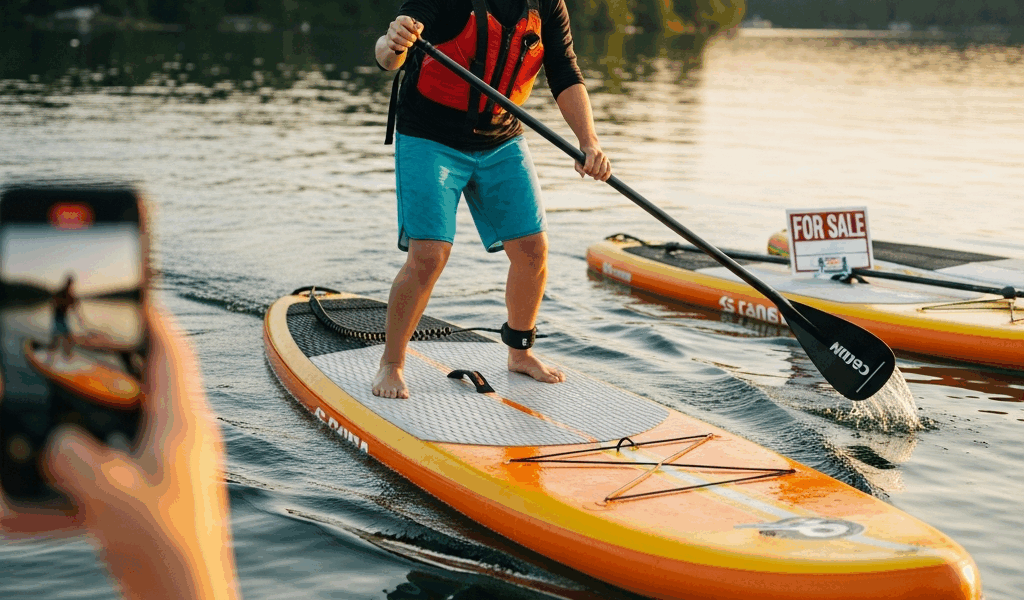
Best Beginner Paddleboard Under $500 — What to Prioritize and What to Skip
If you’re searching for the best beginner SUP under $500, the honest answer is that most of what you’ll find in product reviews is going to push you toward the wrong things. I’ve spent enough time on flatwater lakes and calm bay inlets watching brand-new paddleboarders wobble their way off narrow boards to know that the marketing around budget SUPs is almost entirely backwards. The boards that get promoted hardest are often the ones with the worst specs for someone who is learning. This article is about fixing that.
Pulled into the paddleboard market by a summer rental experience that I can only describe as “one part humiliating, two parts addicting,” I ended up doing a deep dive into what actually separates a good beginner board from a bad one. Spoiler: it’s not the color, it’s not the carbon fiber paddle upgrade, and it’s definitely not whether the board is marketed for “yoga, fitness, touring, AND surfing.” Here’s what I learned.
What Beginners Actually Need — Stability, Not Performance
Width. That’s the number. If you take nothing else from this article, take that.
A paddleboard that is 32 to 34 inches wide behaves completely differently underfoot than one that is 28 to 30 inches wide. The difference isn’t subtle — it’s the difference between standing up on your first attempt and spending 45 minutes swimming next to your board while your friends pretend not to watch from shore. Performance-oriented boards are narrower because narrow boards cut through water faster and track better. None of that matters when you’re learning. None of it.
The second number that matters is volume, measured in liters. Volume determines how much weight a board can support while still riding high enough in the water to be stable. Here’s the rule: the board’s maximum weight rating should be at least 20 percent higher than your body weight for comfortable learning. A 220-pound paddler on a board rated for 220 pounds is not going to have a good time. That board’s practical comfortable riding weight is closer to 180 pounds. The remaining 40 pounds of rated capacity exists on paper only — technically afloat, functionally miserable.
Most budget boards in the 10-foot range have volumes between 200 and 280 liters. Check the spec sheet. If the product page doesn’t list volume in liters, I’ll explain in a later section why that is a red flag.
The boards most beginners will actually use are being paddled on flatwater lakes, calm bay inlets, and slow rivers. Not waves. Not ocean swells. In that context, stability is the only performance metric that matters in the first three months. Buy the boring wide board. You can always buy a narrower board later when you’ve developed balance and are genuinely ready for it.
Inflatable vs Hardboard — The Practical Decision
I made the mistake of assuming hardboards were always better and dragging a 10’6″ epoxy board to a lake an hour from home without a roof rack. Do not do this. The back of a sedan is not a viable transport solution for a hardboard. I know this from experience, and from the very specific memory of jamming a board through a partially open hatchback at 7 a.m. while my coffee got cold.
The practical case for inflatable boards at the beginner level is overwhelming for most people. Deflated and rolled up, an inflatable SUP fits into a backpack the size of a large hiking pack. It goes in a car trunk. It goes in a closet. It doesn’t require a garage wall mount or a roof rack system that costs another $200-300 to install. When you fall on an inflatable — and you will fall — it doesn’t bruise your shins the way a hard epoxy rail does. If you clip a dock or a rock, the board flexes instead of cracking.
The legitimate downsides of inflatables are real but mostly irrelevant for beginners. Inflatable boards flex slightly underfoot, which experienced paddlers find inefficient — that flex absorbs some of your paddle stroke energy. Setup takes 8-12 minutes with a hand pump or 3-4 minutes with an electric pump. Hardboards track marginally better. But if the practical reality of your life means the inflatable actually makes it to the water and the hardboard stays in the garage, the inflatable is the better board.
The exception: if you have a garage, a roof rack or a truck bed, and a paddling spot within 20 minutes of home, a hardboard at this price point is worth serious consideration. You’ll get stiffer feel, better tracking, and no inflation setup in exchange for the transport complexity.
Boards Actually Worth Buying Under $500
There are three boards I’d send a beginner to look at in 2024 at this price range, and one of them is well under $500.
The iROCKER Sport sits at $399-$449 depending on when you catch a sale, and it includes a double-action hand pump, an adjustable paddle, a coil leash, and a backpack carry bag. It measures 10 feet long and 32 inches wide — that width is exactly what you want. The kit is complete enough that you don’t need to buy anything extra to get on the water. The double-action pump (inflates on both the push and pull stroke) makes a real difference vs the single-action pumps included with cheaper boards.
The Roc Inflatable SUP runs $299-$350 and is lighter than the iROCKER, which matters if you’re carrying it any distance from a parking lot. The included pump is smaller and single-action, which is a minor annoyance. Good board for calmer conditions, and the price leaves room in budget to upgrade the paddle separately if you want to.
The SereneLife SLSUPB16 comes in under $300 and is genuinely functional for calm flatwater. Basic everything — basic pump, basic paddle, basic bag — but it holds air, it’s 32 inches wide, and it will get someone on the water. It’s not a forever board. It’s a “let me confirm I actually like this sport before I spend more” board, which is a completely legitimate purchase.
When evaluating any board in this price range, check for these specific features:
- D-ring leash attachment point — this should be on the tail of the board, not just the nose
- US fin box — the standard universal fin system; proprietary fin boxes mean you’re stuck with whatever the manufacturer sells
- Center carry handle — sounds obvious but some budget boards have off-center handles that make a 20-pound wet board feel much heavier
- Double-action pump — inflates on push and pull stroke, cuts inflation time roughly in half
- Volume listed in liters — on the spec sheet, not buried in a marketing paragraph
What to Avoid — Marketing Red Flags at This Price Point
Probably should have opened with this section, honestly. The number of people who’ve bought boards they regret is large enough that it’s worth going through these carefully.
Boards under $200 with vague specs. There are dozens of no-name inflatables on Amazon in the $150-$199 range. The construction method for a good inflatable board is drop-stitch — thousands of threads connecting the top and bottom layers so the board holds a rigid shape at pressure. Cheaper boards use thinner drop-stitch fabric to cut costs. They inflate fine when new. Within one to two seasons, micro-leaks develop at the seams, and you spend half your paddle sessions re-pumping a soft board. The spec sheets on these boards frequently omit volume in liters. That omission is not an accident — manufacturers who know the buoyancy math doesn’t work in their favor don’t publish that number.
Boards marketed for everything simultaneously. “Ideal for yoga, fitness, touring, surfing, and fishing” is not a feature list. It’s a sign that the board has not been optimized for any specific use case. Every one of those activities benefits from a different board shape. A yoga SUP wants extreme width and a soft deck pad. A touring board wants a pointed nose and length for tracking. A surf SUP wants a narrow tail and rocker. A board “designed” for all of them is designed for none of them. Beginners need a board optimized for one thing: stability on flatwater. Buy the boring board.
Performance language directed at beginners. “Lightweight carbon-fiber paddle” on a $250 package board is a marketing claim, not a specification. The carbon fiber content on budget paddles is usually a thin cosmetic layer over fiberglass. Real carbon paddles start at $100-$150 sold separately. If a budget all-in-one package is putting carbon fiber in the headline, ask what they’re not talking about — usually the board construction.
Ultra-lightweight claims at budget price points. Weight reduction in paddleboards costs money. A genuinely lightweight inflatable uses higher-grade materials and tighter construction tolerances. If a board claims to be exceptionally light and costs $179, the weight is coming from somewhere — usually thinner drop-stitch and thinner PVC outer layers. It’s still technically a paddleboard. It just won’t last as long.
The Safety Gear You Also Need
The board is not the only purchase here. These items are not optional extras.
A leash. This is the single most important safety item for paddleboarding, full stop. When you fall — again, you will fall, everyone falls — the leash is what keeps your board from blowing or drifting 200 yards away from you in open water. A paddleboard is a flotation device. Without it, you’re swimming. Many bodies of water require a leash by local ordinance. The coil leash that comes with the iROCKER package is adequate. For flatwater, a coil leash works better than a straight leash because it doesn’t drag in the water behind you.
A personal flotation device. The US Coast Guard classifies paddleboards as vessels, which means you are legally required to have a Coast Guard-approved PFD on board. Required to wear it in certain states and in all conditions where there’s any meaningful risk. An inflatable belt PFD ($60-$90) is comfortable enough that you’ll actually wear it instead of leaving it on the board as a legal technicality.
A paddle fitted to your height. The rough formula: your height plus 6 to 10 inches. Most budget package boards include adjustable paddles — confirm the adjustment range covers your height before purchasing. A paddle that’s too short forces you to hunch. A paddle too long makes your stroke inefficient and tiring.
A dry bag for your phone. A $10-$15 waterproof pouch on a lanyard around your neck. Phones and paddleboarding coexist poorly. This is a cheap fix to an expensive problem.
The beginner SUP market under $500 isn’t complicated once you ignore the marketing noise. Width over 32 inches, volume rated well above your body weight, inflatable for most real-life transport situations, and a complete kit so you don’t need to immediately spend more to get on the water. The iROCKER Sport hits all of those at $399-$449. The Roc gets there for less if budget is genuinely tight. Skip the no-name $150 boards, skip the “multi-sport” everything boards, and buy the boring wide stable platform that will actually keep you upright long enough to decide whether you love this.
You’ll know within your first three sessions. Paddleboarding on a calm lake on a summer morning is genuinely one of the better ways to spend two hours. Getting there with the right board makes that first experience what it should be — not a frustrating swim.


Stay in the loop
Get the latest sup spots updates delivered to your inbox.