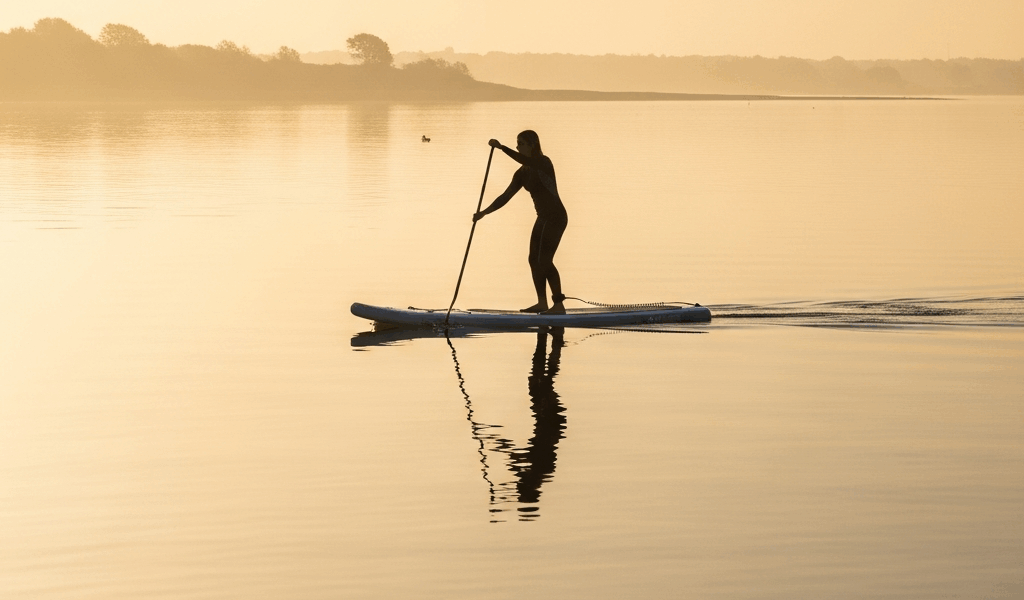
You loaded the board at six, drove forty minutes with coffee between your knees, and pulled into the launch to find the whole bay corduroyed with whitecaps. The wind that was supposed to hold off until ten showed up at seven. You stand there for a minute doing the math on whether it’s worth it, then load the board back up. The morning’s already gone.
Every paddler has a version of that drive. Flatwater paddling, downwinders, and especially wingfoiling and surf are all timing games dressed up as outdoor sports. The skill of showing up at the right hour matters as much as anything you do once you’re on the water — and it’s the part most of us leave to a hurried glance at a forecast app the night before.
Paddling is a timing game, not a weather game
The good window for your spot is a narrow overlap of variables. Wind speed and direction decide whether you get glass or chop. Tide decides whether a channel is runnable or a flat is paddleable at all. For anyone chasing a downwinder or a wing session, you actually want wind — but the right wind, in the right direction, at a strength that’s fun instead of frightening. That overlap might be ninety minutes on a Tuesday and nonexistent on the Saturday you actually had free.
Forecasts hold all of this, and the data is genuinely good now. The failure isn’t the forecast — it’s the human in the loop. You check it once, you remember a vague “morning looks okay,” and the actual window quietly shifts two hours earlier while you’re asleep. By the time you’re standing at the launch, the forecast you acted on is a day old and wrong.
Put the good window on your calendar

Here’s a better loop. Instead of you remembering to re-check the forecast, let the forecast come to you — in the one place you already plan your week. A service called LiveCal is built for exactly this kind of live, conditions-driven event. You tell it what you want to track — wind and water conditions for your spot — it confirms a live feed exists, and it drops the favorable window onto your Google Calendar as a real event. As the forecast updates, it patches that event in place rather than making you go look.
Wind and water condition forecasts for paddling, surfing, and wingfoiling are squarely the kind of thing it’s designed to watch. The practical effect is that your “Saturday paddle” stops being a hopeful guess and becomes a calendar block that moves with reality. If the clean window slides from 8 a.m. to 6:30, the event on your calendar slides with it. Because it writes to the Google Calendar you already use, the session sits right next to the rest of your day, so planning around it is automatic.
Setting it up for your home spot
The trick is being specific about what “good” means for you, because it’s different for every discipline. A flatwater paddler wants low wind and a workable tide. A downwinder wants a sustained cross-shore breeze in a particular direction. A wingfoiler wants real wind — fifteen knots and up — that a flatwater paddler would call a write-off. Define your window around the conditions you actually want, not a generic “nice day,” and the calendar block becomes something you can trust enough to plan a morning around.
Once it’s wired up, the behavior change is the whole point. You stop opening three forecast apps and triangulating. You glance at your week, see the paddle block sitting on Thursday morning where the conditions actually line up, and you protect that time the way you’d protect a meeting. The decision moves from the trailhead at 6 a.m. — where it’s emotional and already too late — back to the calmer place where you plan everything else.
What the forecast still can’t tell you
A self-updating calendar is a planning tool, not a substitute for judgment at the water’s edge. Local effects — a thermal that fills in early, a swell wrapping a point, boat traffic on a summer weekend — are things you’ll only read once you’re standing there. Keep checking the live conditions when you arrive, and keep the habit of looking at the actual water before you commit. The automation handles the part it’s good at: making sure you’re standing there at the right hour in the first place.
The paddlers who consistently score the glass aren’t luckier than you. They’ve just removed the weakest link — their own memory — from the timing decision. Let the good window find its way onto your calendar, and most of those regretful drives home simply stop happening.


Stay in the loop
Get the latest sup spots updates delivered to your inbox.