What Spin-Out Actually Means on a SUP
SUP turning has gotten complicated with all the vague, contradictory advice flying around. “Keep your weight centered.” “Trust your fins.” “Engage your core.” Cool. None of that told me why my tail kept sliding out every time I committed to a turn.
As someone who spent an entire first season blaming my board, I learned everything there is to know about spin-out the hard way. Today, I will share it all with you.
But what is spin-out, exactly? In essence, it’s the moment your tail breaks loose and pivots sideways beneath you — often right when you thought the stroke was locked in and your weight was balanced. But it’s much more than just sliding around. It’s instantaneous. Your rail catches, the board goes perpendicular, and you’re suddenly pointed somewhere you never intended to go. Not a playful skid. Not a controlled pivot. Just chaos.
Spin-out is your board communicating that something is wrong. The frustrating part is figuring out what. Is it the fin? Your stance? Your paddle mechanics? Most SUP content lumps all three into the same vague paragraph. This article doesn’t do that. So, without further ado, let’s dive in.
Check Your Fin First
Start here. Before you rethink your stance or dissect your paddle stroke, look at the fin. It’s the fastest variable to eliminate — and somehow the one that gets skipped most.
Fin Size and Design
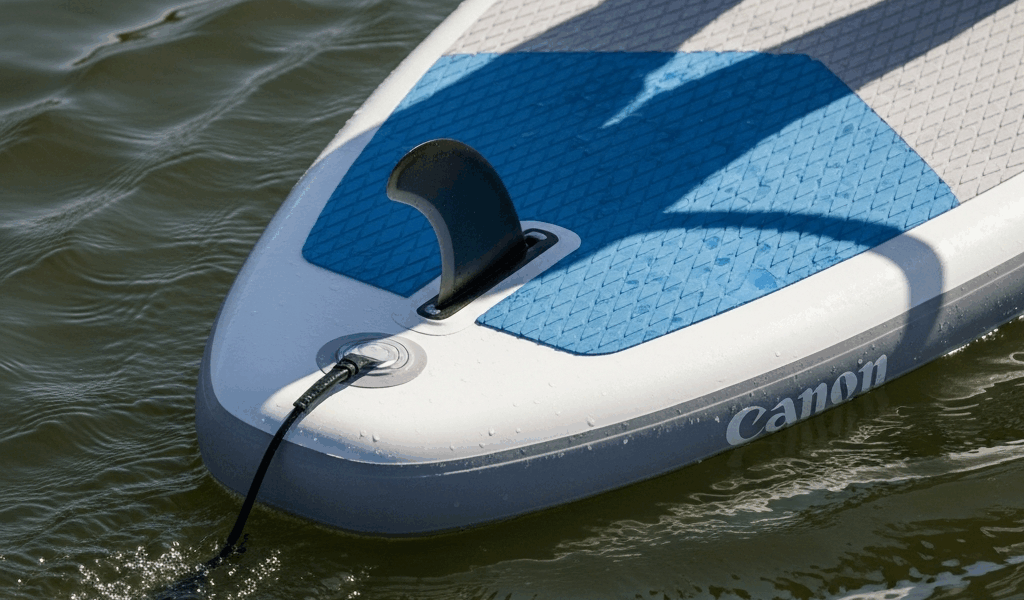
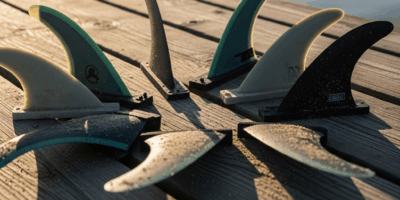
A fin that’s too small simply won’t grip. You need lateral hold — enough depth and surface area to push back against sideways pressure during a turn. Most all-around boards ship with something in the 6-to-8-inch range. If you’re on a 10’6″ board running a 5-inch fin, you’re going to feel that looseness immediately, especially at speed.
Rake matters too. That’s the angle — how far the trailing edge leans back. Less rake means sharper hold. More rake means looser, more playful response. If you’re spinning out constantly, there’s a decent chance you’ve got a high-rake fin on a board that wants something more upright. Don’t overthink it yet. Just check whether your fin’s dimensions are stamped on the base — most are.
Is Your Fin Actually Tight?
I’m apparently someone who paddled three full weeks with a loose fin and blamed everything else. It wasn’t flopping around — just enough play that it shifted under load. The spin-out got worse every session before I figured it out. Don’t make my mistake.
Pull the board from the water. Grab the fin and push it side-to-side. Rock solid. Zero movement. Any give at all means the fin box screw needs attention. A small Phillips head — or a Leatherman Squirt PS4, which is what lives in my dry bag — handles this fine. Snug it firmly. Don’t gorilla it or you’ll strip the box insert.
Where the Fin Sits in the Box
Fore-aft position is adjustable on most US-style fin boxes, and that adjustment matters. Slide the fin forward and you get quicker turn initiation but less tracking hold. Slide it back and stability improves but turning feels sluggish. Most boards have a factory-marked groove or sweet spot — that’s your baseline, not a suggestion.
If your fin keeps drifting forward between sessions, the set screw is backing out. If someone borrowed your board and “tweaked” the fin position, that could absolutely explain sudden spin-out showing up out of nowhere.
Where You Are Standing on the Board
Fin checked and locked down tight? Now pay attention to where your feet actually are when you’re mid-turn.
Standing too far back lifts the nose and unweights the tail. An unweighted tail has nothing to grip with — it just slides. This is the most common mistake I see from paddlers who are getting tired. Fatigue pulls you backward unconsciously. You think you’re searching for stability. You’re actually creating the problem.
Too far forward does the opposite. Nose drops, tail pops up, same result — no edge hold, no grip, spin-out. That’s what makes stance so endearing to us SUP troubleshooters — it fails in both directions, just for different reasons.
Finding Neutral Stance
Your sweet spot typically lands one to two feet behind the board’s midpoint. Most boards have a center carry handle — use it as a visual anchor. Feet roughly equidistant from that handle, maybe slightly aft of it. Some boards have alignment lines pressed into the deck pad. The midline is your landmark.
During a turn, the feet don’t move. Your torso rotates, your paddle plants — stance stays locked. If you notice yourself drifting backward mid-turn, you’re doing it unconsciously. Stay forward of that impulse. Every time.
How Your Paddle Stroke Is Making It Worse
Fin solid. Stance centered. Still spinning out? Then your paddle technique is probably shifting your weight at exactly the wrong moment.
Over-Rotating Your Torso
Too much rotation drags your upper-body weight outside the board’s footprint. Mid-turn, with the rail already loaded, that’s a problem. Keep rotation controlled. Shoulders move — hips stay stacked directly over the board. The moment your hips twist out, you’ve started losing the edge.
The Sweep That’s Too Wide
A wide sweeping arc creates power. It also creates instability during tight turns. Keep the sweep close — inches off the rail, not a foot out into open water. Think of drawing a line along the board’s edge rather than a broad curve away from it.
Planting Behind Your Body
Planting the paddle behind your hip — where you’ve already lost mechanical advantage — pushes weight backward and kills traction. Plant it in front of or beside your stance foot. Once that blade is behind you, the turn is already gone. You’re just reacting at that point.
Try This Drill
Next time you’re out, run a few slow wide turns with one rule: keep the paddle planted beside you the entire time. No sweep, no arc. Just plant and hold. You’ll feel the edge hold differently almost immediately. It’s a weird sensation the first few times — then it clicks.
When the Board Itself Is the Problem
Probably should have opened with this section, honestly — but the truth is that most spin-out isn’t the board’s fault. It’s the three things above. That said, edge cases exist.
Frustrated by mushy, unpredictable response from an inflatable, check your PSI before anything else. Most boards want 12 to 15 PSI depending on rider weight and board volume. An under-inflated board loses structural rigidity — the tail flexes and twists under load instead of holding an edge. Use a pump with an actual gauge. Not a hand pump you’ve had since 2019 with a cracked indicator needle.
Boards with minimal rocker — that’s the bottom curve running nose to tail — can feel squirrely in chop or when you’re transitioning edges quickly. Flat-water cruising shapes often sacrifice rocker for speed. That design works against you the moment conditions get lively.
Fine-lined, fast hull shapes are also harder to turn predictably than wider, more stable platforms. But before you go there: have you genuinely eliminated the fin, stance, and paddle stroke? Because most of the time — most — those three are the actual culprits.
While you won’t need to buy a new board to fix spin-out, you will need a handful of honest sessions paying attention to the basics. First, you should tighten and verify the fin — at least if you haven’t done it recently. A proper fin setup might be the best option, as spin-out almost always traces back to lateral hold. That is because grip at the tail is what everything else depends on. Get the fundamentals locked first. Equipment rarely fixes technique.

Stay in the loop
Get the latest sup spots updates delivered to your inbox.