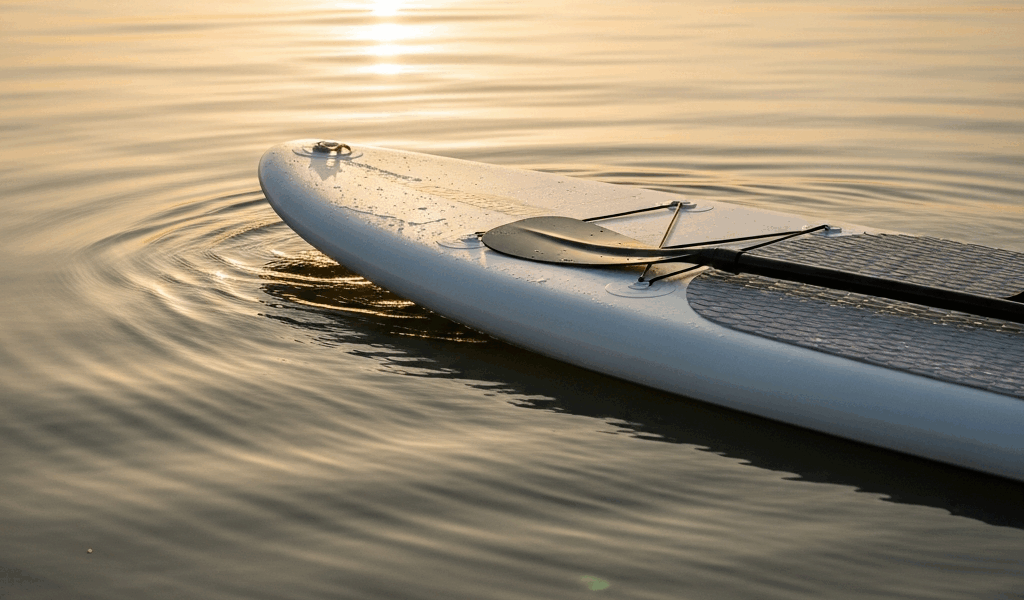
What Actually Happens When You Stop Paddling
SUP balance has gotten complicated with all the conflicting advice flying around. Everyone’s got a tip, a trick, a YouTube video. So let me cut through it.
Here’s the real situation: forward momentum is what keeps your board stable. Stop paddling and that stability vanishes almost instantly. Think of it like a bicycle — lean while you’re coasting and physics keeps you upright. Stop pedaling and suddenly every tiny weight shift becomes a crisis. Same principle, different sport.
While you’re moving, the nose stays committed to a line. Small imbalances get masked. The moment that forward drive disappears, though, you’re just floating on a surface that’s never truly still — waves, wind, your own breathing creating micro-shifts underneath you. Nothing’s counteracting those forces anymore. So the board rocks.
It’s not mystical. It’s physics. And it’s completely fixable once you understand what’s actually going wrong. Today, I’ll share everything I’ve learned about it.
Your Foot Position Is Working Against You
Probably should have opened with this section, honestly.
I didn’t figure out my stance was the problem until a friend watched me paddle and said something I’ll never forget: “Why are you standing like you’re on a tightrope?” She was right. My feet were maybe eight inches apart — nowhere near where they should’ve been. I’d been fighting my own positioning for two full seasons without knowing it.
Don’t make my mistake.
Your feet need to be roughly shoulder-width apart, sitting directly over the board’s centerline. Not diagonal. Not clustered together. Straight across from each other, perpendicular to the board’s length. Most boards have a carry handle molded into the center — that’s your reference point. Your feet belong roughly 12 to 18 inches on either side of that handle, adjusted for your height and the board’s width.
Standing too far forward loads the board’s narrowest point, where side-to-side rocking gets amplified. Standing too far back disconnects your legs from your core, forcing your upper body to compensate constantly. Neither works. Both feel exhausting after about ten minutes.
Find the sweet spot — centered, shoulder-width — and the wobble shrinks dramatically. The board’s widest point now supports your weight. Your center of gravity lines up with the board’s center of buoyancy. Pausing between strokes still means movement, but it stops feeling like you’re about to tip into the water.
Self-check this next time you’re out: look down at your feet while standing in your normal position. Less than 12 inches between them? Move wider. More than 20 inches between your feet and the carry handle? Step forward. Make the adjustment, take a few strokes, feel the difference. It’s immediate.
Your Paddle Is Not Doing Its Job Between Strokes
Most paddlers yank their blade completely out of the water between strokes. Makes sense from a speed standpoint — no drag. But it also abandons your best stability tool at the exact moment you need it most.
I’m apparently someone who learned this the hard way, and keeping the blade engaged between strokes works for me now while lifting it clear never did. The difference was embarrassingly obvious once I tried it.
Instead of pulling the paddle fully out, keep the blade skimming just below the surface during your pause. It doesn’t need to be vertical or generating any power. Flat or at a shallow angle — maybe 15 to 20 degrees from horizontal — barely touching the water. That’s it. This does two things: gives you an immediate platform to brace against if a wobble starts building, and creates subtle drag that dampens the board’s natural rocking.
The technique has a couple names depending on who’s teaching — J-drag, light skim. The blade stays in the water. Not driving, not steering. Just present. When your weight shifts even slightly, you press the blade in and catch yourself. No dramatic flailing. Just a small, confident correction.
A vertical blade creates too much drag and kills your momentum. That’s not the goal. You’re building a safety net, not an anchor.
Once this habit clicks, the wobble often disappears entirely. Your paddle stops being an on-off tool and becomes part of your constant balance system — active between strokes, not just during them.
Board Shape and Volume Are Playing a Role Too
Sometimes it’s not technique. Sometimes it’s the board itself — and that’s worth saying plainly.
But what is board volume, exactly? In essence, it’s the amount of water a board displaces, measured in liters. But it’s much more than that — it determines how the board floats under your specific body weight and how forgiving it is when momentum stops.
A 28-inch-wide racing board at 110 liters will wobble noticeably more than a 32-inch recreational board at 160 liters the moment you stop paddling. That’s not a flaw. Race boards are designed for speed and efficiency, not stationary stability. Fighting that design with technique alone is an uphill battle.
All-around boards — typically 30 to 34 inches wide, 140 liters or more — have more surface area pushing against the water on each side. Harder to rock. Better flotation. Less responsive to small weight shifts. That’s what makes wider all-around shapes endearing to us recreational paddlers who stop frequently to catch our breath, check a map, or just look around.
Take an honest look at what you’re riding. Check the spec sheet or measure near the center of the board. Confirm the volume in liters. If you’re under 28 inches wide or under 130 liters and you’re a beginner-to-intermediate paddler, the wobble might simply be the board working as intended — it’s just not intended for standing still. A wider shape might eliminate the problem entirely without changing a single thing about your technique.
A Simple Drill to Train Your Balance at Rest
So, without further ado, let’s dive in — but start in calm, shallow water. No waves, no wind. Pick a quiet morning if you can.
- Position yourself at the center of the board, feet shoulder-width apart over the carry handle.
- Hold your paddle horizontally at waist height, blade flat on the water surface in front of you.
- Fix your eyes on a specific point on shore. A dock post, a tree, anything stationary. Don’t look at your feet.
- Hold position for 30 seconds without taking a stroke — blade resting lightly on the water.
- Rest 15 seconds. Repeat five times.
- Second round: reduce blade pressure by roughly 25 percent. The blade barely grazes the surface.
- Keep decreasing blade pressure each round until you’re holding balance with ghost-light contact only.
While you won’t need perfect conditions every session, you will need calm water for this drill to actually teach your body anything useful. Choppy conditions introduce too many variables too early.
This trains proprioception — your body’s sense of where it is in space — while the blade still gives you a safety tool during the learning curve. Within a few sessions, your body starts correcting micro-shifts before they become visible wobbles. The corrections happen automatically. That was the goal the whole time.
Wobbling when you stop isn’t a reflection of your athleticism. It’s a skill gap. Fix your foot position. Keep your blade engaged. Match your board to your paddling style. Practice standing still. The wobble disappears — and it stays gone.

Stay in the loop
Get the latest sup spots updates delivered to your inbox.