What Nose Sinking Actually Means and Why It Matters
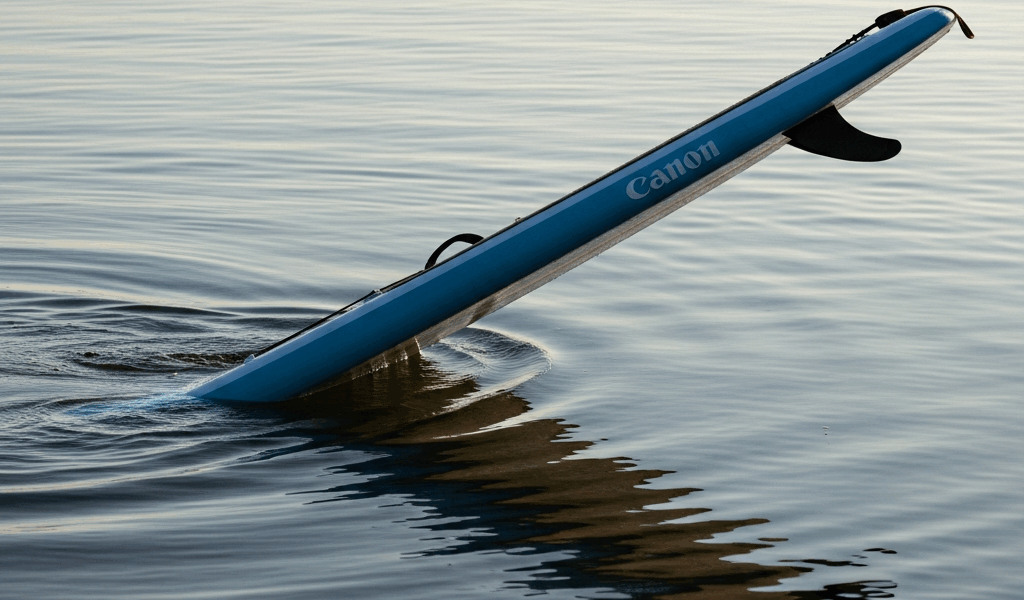
SUP paddling has gotten complicated with all the conflicting advice flying around. But nose sinking? That one’s actually straightforward once you’ve felt it yourself — the front third of your board drops below the waterline, your momentum dies, and steering becomes nearly impossible because your pivot point is now somewhere underwater instead of under your feet.
As someone who spent two full seasons blaming my board for this exact problem, I learned everything there is to know about nose sinking. Today, I will share it all with you.
But what is nose sinking, really? In essence, it’s your board failing to stay level during forward motion. But it’s much more than that. It’s a symptom — of weight placement, volume mismatch, stroke mechanics, or actual gear damage. And it’s almost never the board’s fault out of the box.
Most paddlers immediately start browsing new boards. Don’t make my mistake. The fix is usually three inches of foot position or a small tweak to how your blade enters the water. That’s it.
Your Weight Is Too Far Forward on the Board
This is the culprit roughly 70 percent of the time. I’ve watched paddler after paddler do this without realizing it — and I did it constantly during my first season on a 10’6″ Thurso Surf Waterwalker.
Every time you lean into a stroke, your upper body momentum wants to carry forward. Your center of gravity creeps toward the nose. On flat water, maybe nothing happens. Add chop, add speed, add any kind of resistance — that small weight shift compounds fast. The nose catches water and down it goes.
Here’s your reference point: the carry handle on your board marks its center. Your feet belong on or slightly behind that handle — never in front of it. Look down right now while you’re standing on your board. Where are your feet?
The fix is mechanical and repeatable. After every three or four strokes, consciously reset your stance. Step back slightly. Feel your weight settle toward the middle and tail. You’re not moving dramatically — honestly, we’re talking maybe four inches. It becomes automatic after two or three sessions on the water.
Paddling a 10-foot all-around board? Your ideal stance is usually around the 7.5 to 8-foot mark from the nose. Longer touring boards at 12 or 14 feet? Move back proportionally. The rule holds regardless of what you’re riding.
Your Board Volume Is Too Low for Your Body Weight
Probably should have opened with this section, honestly.
Board volume — measured in liters — determines how much weight your board can float before performance starts falling apart. Every manufacturer prints a weight range on their spec sheet. If you’re near the upper end, or worse, past it, nose sinking becomes almost inevitable.
But what is volume capacity, really? In essence, it’s a performance threshold, not a safety cliff. But it’s much more than that. A 200-pound paddler on a board rated for 200–250 pounds will stay afloat, sure. The board just sits deeper in the water. The nose gets more vulnerable. Speed drops. And yes — the nose sinks easier, especially in anything but glass-calm conditions.
Most recreational SUP paddlers need a minimum of 30–40 liters of volume for every 10 kg of body weight. A 180-pound paddler — roughly 82 kg — should be targeting at least 246–328 liters of total board volume. A 220-pound paddler needs somewhere in the 300–400 liter range.
This is where board shopping gets painfully real. A budget 10-foot hard board from a big-box retailer — the kind sitting in the back of a sporting goods store for $499 — often rates around 200–220 liters. If you weigh 200 pounds, you’re already at the edge. Add a dry bag, a leash, and any kind of wind resistance, and there’s simply no volume margin left. The nose sinks because the math doesn’t work.
Check your board’s spec sheet. If your weight plus gear lands within 10–15 pounds of the maximum rating, the board is undersized for your paddling style. An 11-foot touring board typically gives you 280–320 liters — that breathing room is what keeps the nose where it belongs.
Your Paddle Stroke Angle Is Pushing the Nose Down
This one gets overlooked constantly. That’s what makes fixing it so satisfying to SUP paddlers who finally figure it out — suddenly everything clicks.
Watch someone paddling incorrectly from the side. Their blade reaches far forward, almost in front of their toes. Then it pulls down and back at a shallow angle — maybe 45 degrees from horizontal. That shallow angle creates a downward force vector. Every single stroke is actively pushing the nose underwater. They’ve been fighting their own technique the whole time.
The correct stroke looks different. Blade entry happens close to the board rail, right alongside your feet. Arms stay mostly extended. You pull the blade straight back in a nearly vertical plane — not angled down, not pushed out. The blade exits around your hip. No dramatic reach. No downward push. Just clean backward motion that doesn’t fight the board’s natural buoyancy.
I’m apparently a low-angle paddler by default — it’s what felt natural starting out — and that shallow stroke was absolutely killing my nose position. High-angle technique works for me now while the old method never actually moved me efficiently.
The fix: shorten your reach consciously. Enter the blade close to the board. Keep your wrists locked, arms extended, pull straight back. It feels slightly awkward for maybe five minutes. Then it becomes natural — and the nose sinking stops almost immediately. So, without further ado, go try it on your next session before adjusting anything else.
When Nose Sinking Means Something Is Actually Wrong
Sometimes the board itself is damaged. Not often. But it happens.
On hard boards, look for delamination — that’s the separation between the foam core and the outer fiberglass or epoxy shell. Run your hand along the nose section. Press lightly. A soft spot or a hollow sound means the core is compromised. Waterlogged foam adds weight exactly where you least want it, and the nose sinks because there’s simply less buoyancy up front than there was originally.
Cheaper hard boards are more susceptible to this. Frustrated by a run of delaminating entry-level boards, several smaller manufacturers started using higher-density EPS cores in the early 2010s using what were essentially construction-grade foam insulation techniques. This new idea took off several years later and eventually evolved into the layered construction enthusiasts know and rely on today — but plenty of older budget boards never got that upgrade.
On inflatable boards, check the PSI first. Most iSUPs — including popular models like the Red Paddle Co. Ride 10’6″ and the iROCKER Cruiser — recommend 15–17 PSI for recreational use. If your board is sitting at 12 PSI and feels soft underfoot, lost pressure is your culprit. A slow leak kills rigidity, the board flexes under load, and the nose dips. Inflate it to spec and test again.
While you won’t need a professional repair kit for a basic puncture, you will need a handful of basic supplies — a spray bottle, dish soap, a patch kit that matches your board material. First, you should mist the entire inflated board with soapy water — at least if you want to actually find a slow leak. Bubbles will show you exactly where the hole is. Most patch kits run $15–30 and fix the problem completely.
Hard boards with significant delamination usually aren’t worth repairing. Replacement is the move there.
Ruling out gear damage is the last diagnostic step, though. Start with weight distribution and stroke mechanics — that’s where the real answer lives about 90 percent of the time.



Stay in the loop
Get the latest sup spots updates delivered to your inbox.