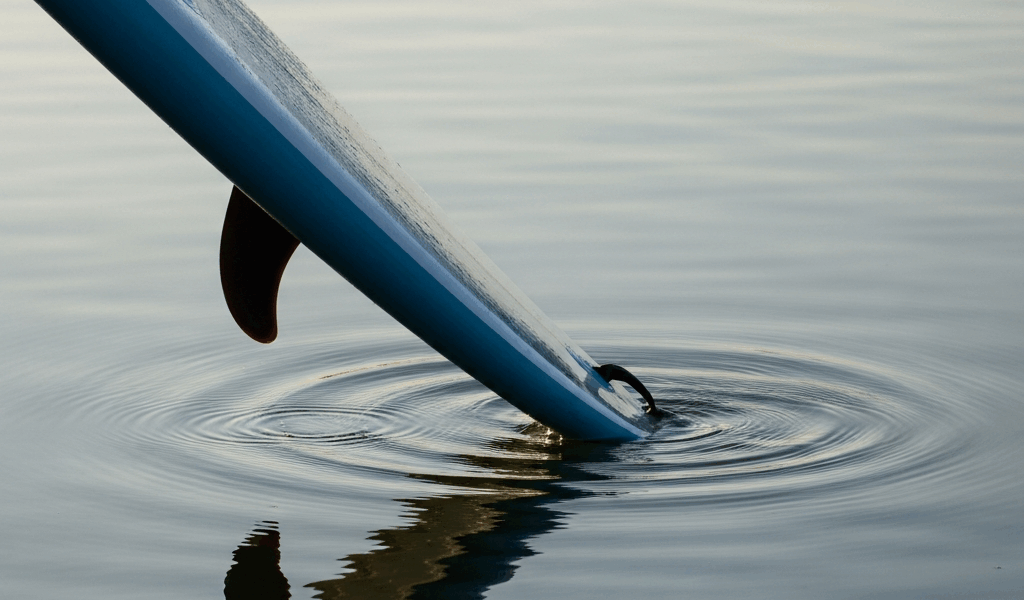
Why Slow Speed Makes Instability Worse
SUP stability has gotten complicated with all the conflicting advice flying around. But here’s the thing nobody leads with: slow speed is usually the actual villain.
When your board moves forward, water flowing underneath creates directional resistance — basically a force that wants to keep everything tracking straight. Kill your momentum and that force disappears entirely. You’re suddenly standing on a platform with zero physics helping you stay upright.
Every tiny weight shift becomes visible. Every ripple. Every slightly off paddle stroke. The board didn’t change. The conditions didn’t change. You just removed the one stabilizing force that was quietly doing half the work.
Probably should have opened with this section, honestly. I burned an entire season — my first real season on a 10’6″ iSUP — convinced I just had terrible balance. Turns out I was fighting physics the whole time, not some personal coordination deficiency. Don’t make my mistake.
The good news: instability at slow speeds is almost always diagnosable. It’s rarely mysterious. It’s usually one of four specific things — how you’re standing, what board you’re actually on, what fin you’ve got, or what the water is doing. Let’s isolate which one is wrecking your sessions.
Check Your Stance Before Blaming the Board
Start here. This is the culprit roughly 70% of the time.
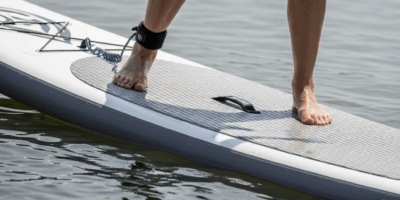
Feet parallel. Hip-width apart. Centered directly over the carry handle. That handle isn’t decorative — it marks the board’s actual balance point, and your weight needs to be over it. Simple enough in theory, genuinely hard to maintain when you’re nervous on the water.
The most common mistake is drifting toward the tail. I did this for months without realizing it. When you feel wobbly, your instinct is to creep backward, searching for something that feels more solid. That position doesn’t exist back there. Moving toward the tail lifts the nose, loads extra pressure onto a smaller surface area, and increases pivoting. Everything gets worse, not better.
Here’s a self-check you can run mid-session without stopping:
- Plant your paddle across the deck in front of you
- Look down at your feet relative to the carry handle
- Your front foot should sit roughly 12 to 18 inches ahead of it, back foot about 12 inches behind
- If your back foot is anywhere near the tail, move forward immediately
Knees matter too. Locked straight knees kill your ability to absorb micro-movements — every small wave hits like a destabilizing jolt instead of something you can roll through. Bend them slightly. Keep them soft. And eyes up: looking down at the water compresses your posture and pitches your weight forward in ways that feel subtle but aren’t.
Bent knees. Eyes on the horizon. Centered stance. Give it five solid minutes before diagnosing anything else.
How Board Volume and Width Affect Stability
But what is board volume, really? In essence, it’s a measure of how much water your board displaces — expressed in liters. But it’s much more than that. It determines how high your board sits, how much buoyancy margin you have, and how aggressively you’ll need to micromanage your balance at any given moment.
Insufficient volume for your body weight means the board rides low, gives you almost no forgiveness, and forces constant correction. A rough guideline: multiply your weight in pounds by 0.6 to get your minimum recommended volume in liters. A 180-pound paddler wants at least 108 liters. A 200-pound paddler on an 85-liter race board isn’t experiencing a skill problem — that’s a gear mismatch, full stop.
Check the spec sheet on your board’s product page. Most manufacturers list volume right there. If you can’t find it, measure length × width × thickness in inches, multiply by 0.016, and you’ll get a rough estimate.
Width is the other number worth knowing. Boards under 30 inches feel noticeably twitchy for most adults on flat water or light chop. All-around boards typically run 30 to 32 inches wide. Racing boards drop to 26 to 28 inches. I’m apparently a 175-pound paddler with average balance, and a 31-inch board works for me while anything under 29 inches never feels right — even on calm days.
Rocker plays a role too — that’s the nose-to-tail curvature of the board. High rocker pivots easily and feels unstable at low speeds. Flatter rocker tracks straighter. Most recreational all-around boards land somewhere in the middle, but rentals and borrowed boards are a wildcard. Worth asking about before you blame your paddling.
Fin Setup Problems That Cause Wobble
Frustrated by a fin that kept rattling loose in its socket, I spent about three weeks testing every center fin configuration I could find — including a FCS-compatible 9-inch Futures-style setup using a slightly different base plate — and learned everything there is to know about how dramatically fin choice affects tracking. Today, I’ll share it all with you.
A fin that’s too small simply won’t hold a line. You’ll spend every stroke making a corrective adjustment just to keep the nose pointed forward. That constant micromanagement registers in your body as instability — even though the board itself is perfectly fine.
Most all-around SUP boards ship with a 7- to 8-inch center fin. If you’ve swapped in something smaller — say a 5- or 6-inch option — or if your fin has visible cracks or worn edges, tracking degrades immediately. Run your hand along the fin. Soft spots, chips, or any wobble in the box means it’s time to replace it.
Configuration matters too. A thruster setup — three smaller fins — works well for surf and tight maneuvering, but it actively reduces straight-line tracking on flat water. That forces constant correction, which feels exactly like instability. Flat water paddling wants a single center fin or a 2+1 setup. Wrong fin for your conditions creates a problem that feels like a skill gap.
Quick sizing reference: flat calm water, go 8 to 10 inches. Choppy water or light current, 7 to 8 inches. Waves or surf, small thruster fins. That’s what makes this detail endearing to us SUP troubleshooters — it’s a $30 fix that solves what felt like an unfixable problem.
Water Conditions That Amplify the Problem
Sometimes your stance is right, your board volume checks out, your fin is solid — and the water is still wrecking you. That’s real too.
Wind chop creates constant surface disruption. Boat wakes carry concentrated energy. Shallow water develops turbulent, unpredictable flow patterns underneath your board. Any of these conditions will expose instability that would be completely invisible on a glassy lake at 7am.
Windy days hit especially hard at low speeds. Paddling at 1 to 2 mph into a 12 mph wind with 6-inch chop means every small wave deflects your board slightly. Your brain reads it as wobbling. It’s not — it’s just physics being physics in difficult conditions.
The practical fix: increase your paddle cadence. Not harder strokes — steadier ones. Even modest forward momentum counters instability in ways that raw power doesn’t. Rhythmic and consistent beats strong but erratic every time.
And if conditions are genuinely rough — sustained wind above 15 mph, heavy boat traffic, moving current — slow paddling is hard for everyone. That’s not you.
Quick Reference — Most Common Cause-and-Fix Pairs
- Standing too far back → Move feet forward, center over the carry handle
- Locked knees → Soften the knees, stay loose in your hips
- Board too narrow or low volume → Upgrade to 30-plus inches wide and appropriate liters for your weight
- Fin too small or worn → Swap in a fresh 8-inch center fin
- Choppy conditions → Increase paddle cadence to rebuild forward momentum
Start with stance. Always. It solves the problem most of the time, costs nothing, and takes five minutes to test. If that doesn’t move the needle, pull up your board’s spec sheet and check the numbers. Then look at the fin. Conditions are rarely the whole story — they just make everything else louder.



Stay in the loop
Get the latest sup spots updates delivered to your inbox.