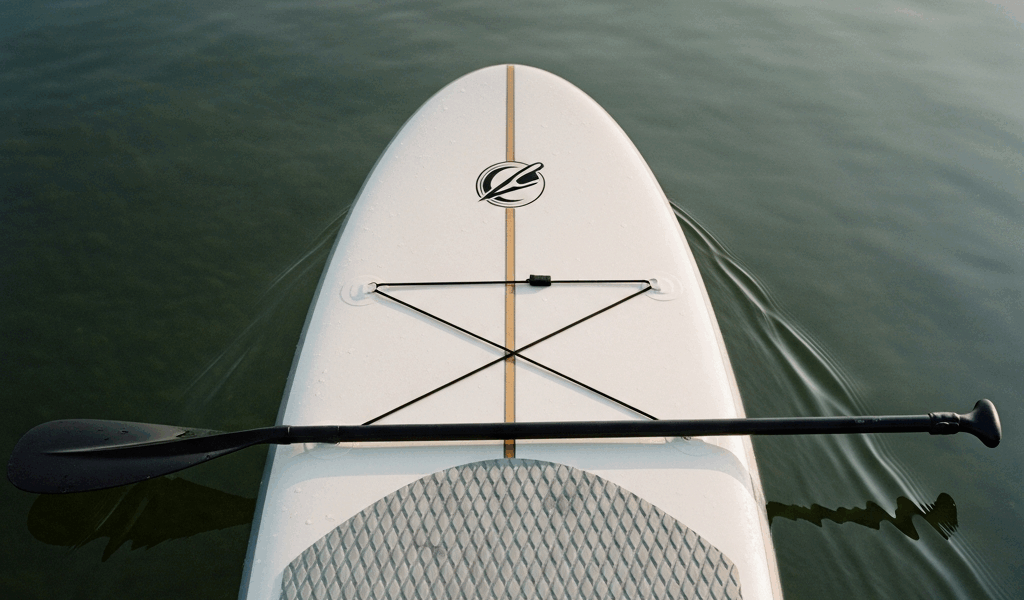
SUP Tracking Has Gotten Complicated With All the Bad Advice Flying Around
Your SUP keeps spinning, and you’re paddling harder than literally everyone else on the water. Other paddlers glide past like they’re on rails while your board drifts sideways — constantly, stubbornly, like it’s actively disagreeing with you. I’ve been there. More times than I’d like to admit.
But what is a tracking problem, really? In essence, it’s your board’s refusal to hold a straight line. But it’s much more than that — it’s usually four separate issues disguised as one, and most people never isolate which one is actually wrecking their session.
Today, I will share it all with you. The technique problems, the fin stuff, the stance fixes, and the honest conversation about whether your board is just the wrong tool. So, without further ado, let’s dive in.
The Most Common Reasons a SUP Tracks Poorly
Here’s the short version: your board won’t hold a line because of your paddle technique, your fin setup, your stance, or the board’s shape. One of those four. Sometimes two. Rarely all of them at once — though I managed that combination my first season, so don’t rule it out.
Most articles throw everything together and tell you to “paddle better” or “buy a longer paddle.” That’s not a diagnosis. It’s a guess. What follows is how to test each system so you know exactly what’s failing — and exactly what to fix.
Paddle Technique Problems That Cause Spinning
Bad paddle technique is the most common culprit. Also the most fixable. I learned this the hard way during a rental session in Maui — paddling like I was swinging a Louisville Slugger — until my instructor watched for about thirty seconds and said, flatly, “Your blade is doing a half-sweep instead of a stroke.” That was 2019. I think about it every single time I paddle.
When your blade moves parallel to the board’s centerline, it pushes you forward. When it angles outward — even slightly — it steers you sideways instead. Most beginners pull the paddle too far behind their hip. The blade angles outward at the end of the stroke. Six strokes later, you’ve drifted fifteen degrees without realizing it. That’s the whole problem, usually.
The second technical error is almost as common. Pulling with your elbow instead of your core makes a straight blade path nearly impossible — the motion becomes a push-pull rather than a clean forward drive. Your blade curves. Your board follows.
Test yourself right now. Count how many strokes you take per side before the board drifts noticeably. Three or four strokes before switching is solid. Two strokes? Your blade is sweeping. Six or seven? Honestly, cleaner technique than most people on the water.
Advanced paddlers use the J-stroke — a subtle correction at the end of each stroke — to eliminate switching sides entirely. Don’t start there. Master the straight stroke first. Don’t make my mistake of trying to learn the correction before learning the thing it corrects.
Fin Setup and How It Affects Your Tracking
Probably should have opened with this section, honestly. A loose or missing fin destroys tracking instantly — and it’s a little embarrassing how often this turns out to be the actual problem.
Check your fin box screw right now. Unscrew it. Tighten it again. Is the fin fully seated with no gap between the base and the board? That takes thirty seconds and fixes roughly fifteen percent of “my board won’t track” complaints. Fifteen percent.
Beyond that — fin setup matters more than most paddlers realize. A single-fin configuration (one large center fin, standard on most all-around boards) tracks better than a thruster setup. The center fin does the tracking work. Side fins improve turning and responsiveness, not straight-line stability. I’m apparently a single-fin paddler, and removing the side fins on my 10’6″ Bluefin worked immediately while the thruster config never felt right to me on flatwater.
Fin size makes a real difference too. A larger center fin — say 9 inches instead of 7 — improves tracking significantly. If your board uses a standard US fin box, a larger center fin costs somewhere between $20 and $45 and is absolutely worth testing before you blame yourself or declare the board junk. That might be the best option, as tracking requires rear-end stability. That is because a larger fin increases surface area resisting lateral drift — simple physics, dramatic results.
Stance and Weight Distribution Fixes
Your feet don’t just keep you upright. They determine whether the board sits flat, nose-up, or nose-down — and each position affects tracking in a completely different way.
Standing too far back raises the nose out of the water. Wind and current catch the exposed nose and push it sideways. The tail follows. Your board starts spinning like a compass needle in a thunderstorm.
Standing too far forward buries the nose. The board goes sluggish. Steering gets weird because the tail has almost no influence on direction anymore.
The sweet spot? Feet centered directly over the carry handle, roughly shoulder-width apart. Works for most paddlers on most boards. On flat water, that position is neutral — and neutral is where you want to start.
Wind changes things. When the board keeps getting shoved sideways into a headwind, shift your weight maybe six inches toward the nose. This sinks the nose slightly, increases water contact, and helps the board punch through wind pressure instead of getting pushed around by it. First, you should try this adjustment — at least if you’re paddling in anything over ten miles per hour of wind.
One more thing: look at the horizon. Not your feet. Your hips follow your eyes — it’s just how balance works — and staring down makes you shift constantly. Looking ahead stabilizes your upper body and keeps the board noticeably flatter on the water. Simple fix. Weirdly hard to remember in the moment.
When the Board Itself Is the Problem
This is the uncomfortable conversation, but it matters. A wide, short all-around board is not built for tracking. It’s built for stability and easy maneuvering. That’s not a flaw — that’s the design. Knowing that changes how you interpret your own frustration.
All-around boards — typically 28 to 32 inches wide and 8 to 10 feet long — prioritize stability for beginners. They trade straight-line tracking for forgiveness, which makes them genuinely good learning tools in calm, controlled water. Crossing open water or paddling any real distance? Different story.
Touring boards — typically 26 to 28 inches wide and 10 to 14 feet long — are built to hold a line. The narrower profile and longer hull give them a natural tendency to track that no amount of technique fixes can fully replicate on a short, wide board.
Here’s a practical threshold: under 10 feet long and over 32 inches wide means tracking will always require active, constant paddle input. Better technique helps. A larger fin helps. But the board itself is working against you — designed for stability, not distance.
That’s what makes touring boards endearing to us distance paddlers. Quality used options — a Red Paddle Co. Voyager, an iRocker Cruiser, a Bluefin Carbon — start around $400 to $600, and the difference in how the board behaves on the water is immediate. Not subtle. Immediate.
This isn’t a failure on your part. It’s a mismatch between tool and task. And identifying that — clearly, specifically — is the diagnosis you actually needed.

Stay in the loop
Get the latest sup spots updates delivered to your inbox.