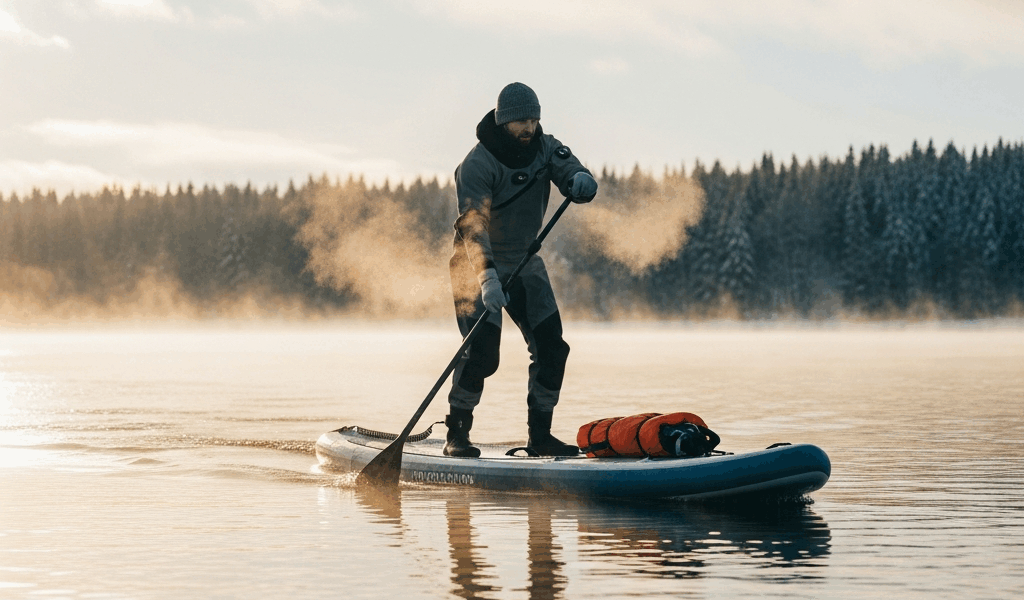
Winter Paddleboarding — How to Stay Safe and Train All Year in Cold Weather
Winter paddleboarding tips tend to fall into two categories online: gear listicles from brands trying to sell you a drysuit, and vague warnings to “be careful out there.” Neither of those actually tells you what you need to know before you step onto a board in January. I’ve been paddling year-round in the Pacific Northwest for about six years, which means I’ve made some bad decisions in cold water and learned from them. The most important thing I can tell you before we get into gear, locations, or training benefits is this: the danger in cold-water SUP is not what most people think it is.
It’s not hypothermia. That surprises almost everyone.
Cold Water vs Cold Air — Dress for the Water, Not the Sky
Here’s the thing that took me an embarrassing amount of time to internalize: a 60-degree air temperature with 45-degree water is a drysuit day. Full stop. I used to look out my window in November, see sunshine, feel the relatively mild air on my face, and assume that was the relevant data. It isn’t. The air temperature is almost irrelevant to your actual risk profile when paddleboarding in winter.
What matters is what happens in the first 90 seconds after you fall in.
When your body hits water below 60 degrees Fahrenheit, you experience something called cold shock response. It’s involuntary. Your body triggers an immediate gasp reflex — a sharp, uncontrolled intake of breath. Your breathing rate spikes to three or four times normal. In some people, there’s a cardiac component. None of this is a gradual process you can think your way through. It happens before your conscious brain has time to form a plan.
This is the mechanism that kills people. Not hypothermia — that’s the gradual core temperature drop that takes 30 to 90 minutes depending on water temperature and body composition. Cold shock operates in the first 30 to 90 seconds of immersion. If you’re alone, if you inhale water during that gasp reflex, if the shock triggers a cardiac event — those outcomes don’t require prolonged exposure. They require about a minute.
Experienced cold-water paddlers have a phrase for this: dress for the swim, not for the paddle. Your gear decisions should be based on what happens if you’re suddenly, unexpectedly in the water. Not on what will keep you comfortable while you’re upright on your board in the morning air.
A PFD — worn, not bungeed to the board — is non-negotiable in cold water precisely because of this. Cold shock can take your voluntary swimming ability offline within seconds. A PFD keeps your airway above water when your arms stop cooperating. This is not hypothetical.
What to Wear — Temperature Thresholds and Gear
Probably should have opened with this section, honestly. Let’s make it concrete.
Water temperature is the number you need. Not air temperature, not the weather app’s “feels like” reading. Most weather services don’t prominently feature water temperature, but NOAA’s buoy data is publicly available and specific. For inland lakes and reservoirs, you’re estimating — water temperatures typically lag air temperatures by four to six weeks in autumn, meaning a lake in a region that’s been cold for two weeks is colder than you think.
Here’s a working framework:
- Above 70°F — Board shorts and a PFD. Normal summer conditions. Cold shock is not a significant factor above this threshold.
- 60–70°F — Wetsuit territory. Minimum 2mm full suit. Neoprene booties are worth adding. This is the range where a lot of recreational paddlers get complacent because the water doesn’t feel that cold at first.
- 50–60°F — 3/2mm full wetsuit minimum. Add neoprene gloves and booties. For sessions over an hour, add a hood. The O’Neill Psycho Tech 3/2mm (around $350) is a reasonable reference point in this range — flexible enough to paddle in, warm enough to actually matter.
- Below 50°F — Drysuit territory. A drysuit keeps you completely dry and allows you to layer wool or synthetic base layers underneath. At this temperature, a wetsuit is a calculated risk, not an adequate solution. Drysuits are expensive — quality entry-level paddling-specific drysuits run $800 to $1,200 — but that cost needs to be weighed against what’s actually at stake.
Driven into the water unexpectedly on a 38-degree February morning, a paddler wearing a wetsuit bought for summer surfing will have less effective swimming time than someone in a properly fitted 3/2mm with a hood and gloves. The difference isn’t philosophical. It’s measurable in seconds of functional capacity.
One specific mistake I made early on: buying neoprene gloves sized for a snug fit like dive gloves. Paddle gloves need to allow grip on the shaft without constriction. The NRS Maverick Mitts (about $55) have a design that actually accommodates a paddle grip. Small detail. Big difference after 40 minutes on the water.
Training Benefits — Why Winter Paddling Makes You Better
Beyond the safety considerations — which are the foundation of all of this — there’s a real performance argument for training through winter. Several of them, actually.
Cold-condition training improves your aerobic threshold. Your cardiovascular system works harder to maintain core temperature, which adds a layer of physiological demand to sessions that look identical on paper to summer paddles. The same 45-minute flatwater session in February is asking more of your body than the same session in July. Paddlers who maintain year-round training typically show better early-season fitness in spring than those who stop in October.
Winter water conditions also offer something summer rarely does: flat water. High-pressure winter systems on inland lakes produce glass-flat conditions that afternoon thermal winds completely destroy from May through August. Some of the best technical training sessions I’ve had were in November, on a reservoir outside Portland, in conditions so flat you could see the blade entry points reflected on the surface. That kind of precision feedback is valuable.
The gear itself changes your training demands in a useful way. Paddling in a 3/2mm wetsuit with booties and gloves shifts your center of gravity subtly and adds resistance to shoulder rotation. Your stabilizer muscles — the small muscles along your spine and around your hips — work harder to maintain balance. After a winter of this, summer paddling in board shorts feels genuinely easier. Your balance base is deeper.
Winter sessions also tend to be shorter by necessity, which forces focus. A two-hour summer social paddle and a 45-minute winter technical session are not the same training stimulus. The winter session usually wins on quality. Less chatting, more paddling, home before it gets dark at 4:30.
Where to Paddle in Winter — Protected Water Is Non-Negotiable
Location selection in winter is not a preference — it’s a safety variable.
Wind is the multiplier that turns manageable cold-water risk into serious danger. A 15 mph wind on a summer day is uncomfortable. A 15 mph wind on 40-degree water, when you’re in cold-shock territory within seconds of immersion and your body heat is being stripped by both the water and wind chill simultaneously, is a different situation. Distance from shore becomes critical because your effective swimming time after cold shock is somewhere between 30 seconds and two minutes depending on the individual, water temperature, and gear.
That’s the swim distance you need to stay within. Not comfortable swimming distance. Cold-shock swimming distance. Those are different numbers.
Good winter paddling locations share a few characteristics:
- Natural windbreaks — bays, coves, reservoirs surrounded by hills or tree lines
- Manageable fetch (the distance wind can travel across open water before hitting you)
- Consistent depth — avoiding shallow, current-exposed sections
- Accessible launch and exit points you don’t have to fight to reach
Flatwater rivers can work if current is below roughly 5 mph. Above that, a swim becomes a rescue situation because the current compounds every other problem. Large exposed lakes in winter are a different calculus than the same lake in August. Coastal ocean in winter swell is expert-only territory with specific rescue planning involved — it’s not simply a more challenging version of summer coastal paddling.
I paddle a specific reservoir about 20 minutes from home through winter. It sits below a ridgeline that blocks the prevailing southwest wind, has a gravel launch, and the deepest point near shore is about 8 feet. I know this water. Familiarity with your specific winter location — its exposure patterns, its typical morning wind versus afternoon wind, where the current runs — is part of the safety infrastructure.
When to Stay Home — Honest Conditions Assessment
This section exists because most paddling content never says this clearly: some days you should not go.
The conditions that require a no-go decision aren’t edge cases. They come up regularly in winter.
Wind above 15 mph combined with cold water: The risk-to-benefit calculation shifts sharply. This isn’t about skill level. It’s about physics and physiology. Cold shock doesn’t respect technical ability.
Paddling alone in cold water: Unacceptable risk regardless of experience. Cold shock can incapacitate anyone. Solo paddling in cold conditions means no one retrieves you in the 60-second window that matters. I’ve paddled with a partner who had to get back before I was ready to leave. I drove home. That’s the call.
Ice forming on the paddle: The water is at or near 32°F. This is well below reasonable recreational paddling conditions. Ice on the paddle means ice on the water is possible, which creates entrapment risk. This is a stay-home indicator, not a dress-warmer indicator.
A simple go/no-go checklist before every cold-weather session:
- Do you know the actual water temperature?
- Is wind under 15 mph for the full duration of your planned session?
- Is someone ashore aware of your location and expected return time?
- Is your gear matched to the water temperature, not the air temperature?
- Are you paddling with at least one other person?
If any of those answers is no, the session either gets modified or it doesn’t happen. The water will be there in April. There’s no training adaptation worth a cold-shock drowning event, and there’s no fitness goal worth the risk of solo immersion in 38-degree water.
Winter paddleboarding is genuinely worth doing. The flat water, the quiet, the physiological adaptations, the satisfaction of not losing four months of fitness every year — those are real. But the version of winter SUP that’s worth doing is the one where accurate risk understanding comes before the session plan. The gear matters. The location matters. The conditions matter. What matters most is knowing exactly which threat you’re actually managing, and building everything else around that.
Cold shock. First 90 seconds. Dress for the water.
Everything else follows from there.


Stay in the loop
Get the latest sup spots updates delivered to your inbox.