The Most Common Reasons Your Fin Comes Loose
SUP fin problems have gotten complicated with all the conflicting advice flying around. As someone who has paddled everything from glassy Santa Monica mornings to choppy open-water crossings, I learned everything there is to know about why fins fail mid-session. Today, I will share it all with you.
That wobble you feel — the one that shows up exactly when you need stability most — is almost never random. Three culprits account for basically every loose fin situation I’ve seen: a stripped or loose fin screw, a damaged fin box, or a straight-up mismatch between your fin type and your board’s system. Before you start pulling things apart, run through this quick mental checklist:
- When did the fin first start coming loose — today or weeks ago?
- Does the screw turn freely or does it feel stuck?
- Can you see the fin box itself moving separately from the board?
- What type of board do you have — hard board, inflatable, or hybrid?
Honest answers here save you from chasing the wrong fix for twenty minutes while your session window closes.
How to Check Your Fin Box for Damage
Probably should have opened with this section, honestly. Most paddlers go straight for the screw, assume that’s the whole story, then wonder why tightening it didn’t help. A cracked or degraded fin box is sneakier — and it matters more than people think.
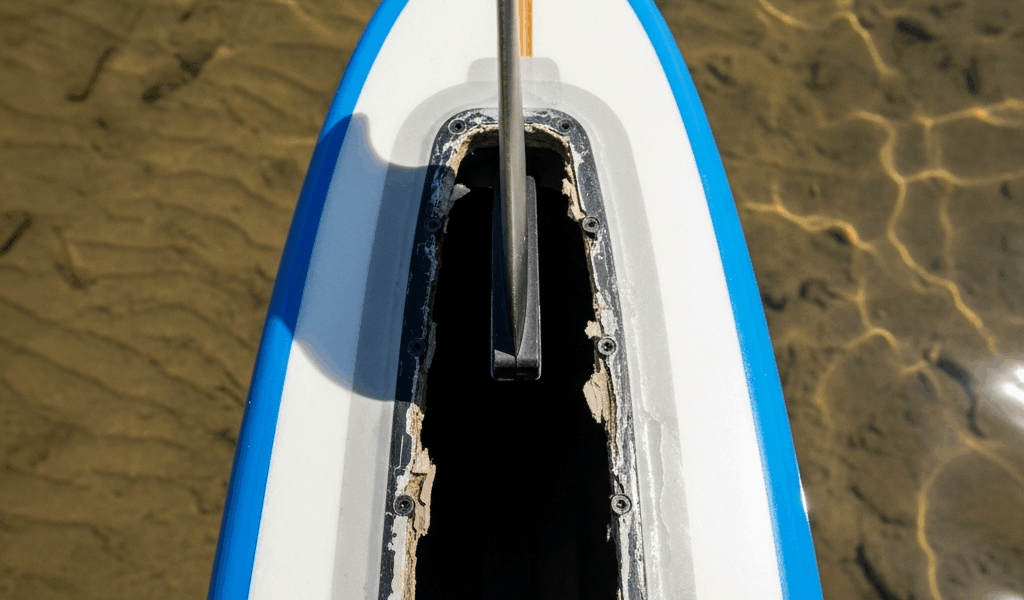
Pull the fin out completely. Look at the edges where the box meets the board. A healthy box sits flush, no gaps, no daylight between the box and surrounding fiberglass. If you spot separation between the box and the resin around it, that’s delamination — the box is physically pulling away from the board structure. Run your fingernail along the seam. Any cracking or slight depression where the box has started sinking inward? It’s degrading.
Next, do a flex test. Grab the base of the empty box and try wiggling it side to side. Should feel like trying to move concrete. Any give at all means the box isn’t properly glassed in anymore. That’s different from a loose screw — a loose screw only moves the fin. A loose box moves everything together. That’s structural.
For inflatable SUPs, the failure looks different. You’ll find cracks in the plastic clip mechanism or warping along the slide channel rather than fiberglass delamination. Check after every few sessions if you’re paddling in sandy water. Sand gets everywhere, and it absolutely speeds up wear on those plastic components.
Fixing a Fin That Won’t Stay Screwed In
But what is a stripped fin screw problem, exactly? In essence, it’s when the nut inside the fin box gets worn down from repeated tightening cycles until the screw turns freely without gripping anything. But it’s much more than that — the same symptoms can mean three different things, each with its own fix.
Your repair options run in order from cheapest to more involved:
- Replace the screw. Grab a stainless steel fin screw — typically M6 x 16mm or M6 x 20mm depending on your fin box depth. Most board shops stock these for under $5. Bring your old screw along to match the threading exactly, because sizing varies more than you’d expect.
- Use a fin nut repair kit. If the box is structurally solid but the nut is shot, brands like FCS make replacement nut sets with fresh stainless hardware. Around $8–12 for a small pack. Worth keeping one in your kit bag permanently.
- Apply thread locker. A single drop of medium-strength thread locker — Loctite 243 is the standard, about $4 a bottle — on a new screw stops it from backing out without permanently bonding the whole assembly. Cheapest prevention measure that actually works.
Don’t make my mistake. Early on I cranked fin screws down as hard as I could, figured tighter meant more secure. Wrong. Overtightening cracks the fin box walls from the inside, especially on boards that have seen a few seasons. Hand-tight plus a quarter turn is the target — you want resistance, not strain.
Carry a spare stainless screw in your board bag. Not as a nice-to-have. As essential gear. Swapping a screw takes 30 seconds. Paddling with a compromised fin setup because you didn’t have one takes the whole rest of your session.
Inflatable vs Hard Board Fin Problems Are Different
Hard boards and inflatable SUPs are not the same animal when fins start failing. That’s what makes fin troubleshooting endearing to us paddlers — the fix for one type is basically useless on the other.
So, without further ado, let’s dive in.
On hard boards, you’re working with fiberglass or epoxy resin fin boxes that delaminate or degrade over time. Mechanical problem, mechanical solution — replace the screw, replace the nut, patch the box. Straightforward.
Inflatable SUPs use either click-in systems, where a locking tab holds the fin, or slide-in channels, where the fin travels down a track on the board’s bottom. These fail differently. A click-in locking tab might be the best option for convenience, as inflatable SUP use requires repeated insertion cycles. That is because after roughly 200–400 uses the tab simply stops gripping. Replacing it means swapping the valve assembly — around $30–50, and not something you’re doing on the beach.
Slide-in channels have their own weakness. Sand. One grain wedged in the channel prevents the fin from seating flush, which creates exactly that wobble you feel underfoot. I’m apparently someone who paddles mostly sandy SoCal breaks, and a 20-second freshwater rinse into the channel after every session works for me while skipping that step never does. Rinse it. Every time.
I paddled a Hala Gear Atcha for two full seasons before I realized the slide-in channel had warped slightly from being stored in direct sun too long. The channel had expanded permanently — no amount of fin adjustment fixed it. The board still worked, but there was always that tiny wobble. Lesson learned: store inflatables in shade, and actually check the channel before launching rather than assuming it’s fine.
How to Stop Your Fin Coming Out Again
While you won’t need a full repair kit every time you paddle, you will need a handful of basics to stay ahead of fin problems before they become session-ending issues.
Build a five-minute pre-paddle check into your routine. Inspect the fin box for visible cracks. Check fin screw tightness — hand-tight plus a quarter turn. Look for sand or debris packed into the box. Confirm the fin sits fully seated with no visible gaps at the base. Every time. It costs less energy than paddling out to discover something’s wrong 400 meters offshore.
After salt water or sandy conditions, rinse the fin box with fresh water. Use a small brush if you have one. Sand packed into the threads is a slow-motion wear problem that compounds over weeks until suddenly the screw strips faster than expected.
Check the fin box edges every few months. You’re looking for tiny stress fractures that haven’t fully split yet — hairline cracks you can catch early and seal with epoxy resin before they become structural. That repair costs maybe $8 in materials. Waiting until the crack runs completely around the box costs $200–500. Or a whole board.
First, you should carry a fin tool and a spare screw at all times — at least if you paddle more than a handful of times a season. A FCS Hex Tool runs $8 and disappears into any board bag pocket. Together with a spare screw they eliminate roughly 80% of on-water fin frustrations.
If the fin box is cracked through — light visible through it, or a crack that goes fully around — stop paddling that board. A cracked fin box leaks water directly into the board core and destroys it from the inside. Catching it early is a one-afternoon repair. Missing it is a board replacement. The difference is just paying attention.



Stay in the loop
Get the latest sup spots updates delivered to your inbox.