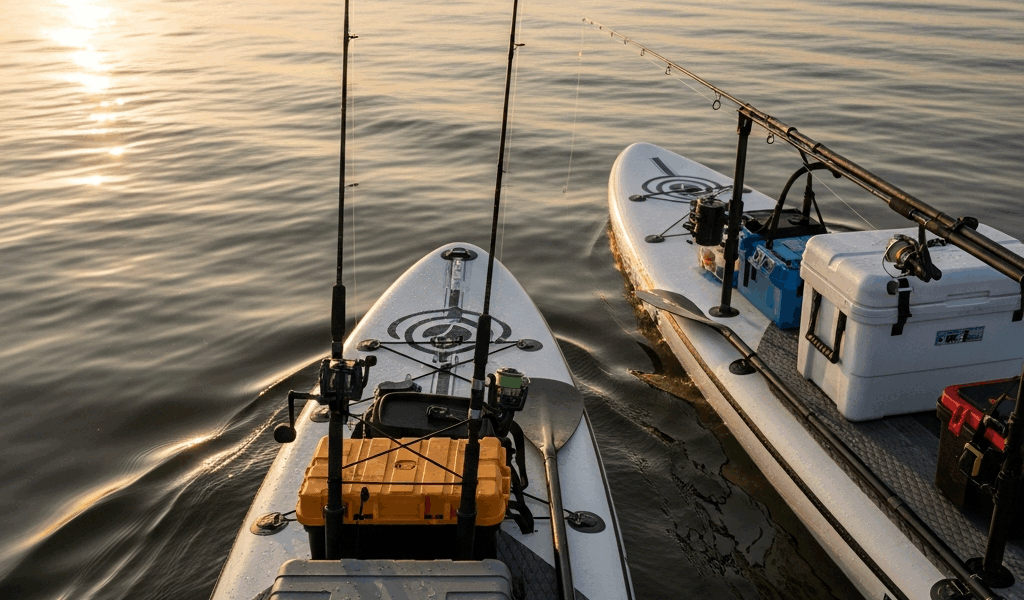
Best Board Type for SUP Fishing
When I first started SUP fishing setup, I made the rookie mistake of grabbing my touring board—a sleek, narrow 28-inch platform designed for speed. That lasted exactly two trips. My balance was terrible, and every cast felt like I was defying physics.
The minimum width you need is 34 inches. Honestly, go wider if you can. I eventually upgraded to a 36-inch all-around board, and the difference was immediate. Stability beats speed when you’re standing one-footed trying to play a striped bass.
You’ve got two main choices: inflatable versus hard boards. Each has real tradeoffs.
Inflatable Boards for Fishing
Inflatables like the iRocker Cruiser or Bluefin Cruise are genuinely excellent for fishing. They’re more forgiving on your knees during long sessions. The surface is softer, which matters when you’re kneeling to work around deck-mounted gear. They’re also cheaper—you can get a solid fishing-ready inflatable for $400–600, whereas hard boards start around $800.
The weight distribution is where inflatables shine. They handle rod holders, coolers, and tackle bags without that tippy feeling a hard board gives you. I’ve spent 8-hour days on my Bluefin without once questioning whether I’d end up swimming.
Durability is the real concern. Inflatables need to be inspected regularly for punctures, and if you fish rocky coastlines, you’re constantly anxious. One sharp shell, and you’re done for the day.
Hard Boards for Fishing
Hard boards offer better glide and speed between fishing spots. A 10’6″ hard board from brands like Naish or Starboard will keep your momentum even loaded with gear. They also last longer—you’re not babying them against rocks.
The deck pad is critical. Stock pads are usually thin. I upgraded to a thicker 10mm pad from Creatures of Leisure ($80–120) because standard pads compress after a season, making your footing slippery when wet. More expensive, sure. But worth not eating paddleboard.
Hard boards demand more width if you’re fishing from them seriously. At 34 inches, you’ll notice every weight shift. At 36–38 inches, you’re comfortable. The tradeoff is that you’re not winning any speed races, but you’re fishing. Speed was never the goal anyway.
Essential Gear Rigging Setup
Rigged by terrible planning and two failed fishing trips, I eventually learned what actually needs to be mounted on your board versus what just weighs you down.
Rod Holder Placement
You need two rod holders minimum. The placement matters more than people realize. I mounted mine at the rear corners of the board—one port, one starboard. This keeps rods out of your casting line and away from your head when you’re moving around.
Deck-mounted rod holders from brands like RAM or Scotty usually run $30–50 each. They require drilling into hard boards or using adhesive pads on inflatables. Avoid cheap suction-cup holders. They fail, and you lose your rod to the ocean.
The angle should be slightly angled down toward the water. A 20-degree angle works. Rods that angle too far back will drag line in the water while you’re paddling, which collects seaweed and creates drag.
Cooler and Tackle Box Attachment
A small cooler should go in the center of your board. I use a 20-quart Yeti Roadie ($250), which sounds expensive until you realize you’re sitting on it, keeping your catch cold, and using it as an anchor point for your feet. Smaller coolers like the RTIC 20 ($80–120) work fine too.
Strap everything down with cam buckle straps. Velcro fails when wet. Bungee cords bounce around. Cam buckles ($8–12 per pair) stay locked. I’ve never had a cooler shift in six years.
Tackle management is personal preference, but I’ve settled on a medium tackle crate mounted behind the cooler. The YakAttack Gear Tray ($40) gives you organized access without taking up tons of space. Soft tackle bags shift in the wind and throw your balance off.
Anchor System
An anchor is non-negotiable if you’re fishing current-heavy areas. A simple rope anchor with a 1.5–2 lb weight works fine for most paddle board fishing. The complete setup runs about $30.
The anchor line should be attached to a cleat mounted at your front handle area, not loose in the deck. Trust me on this. I once left a loose anchor rope on deck. It tangled around my leg while paddling, and I nearly went over.
Anchor in 8–15 feet of water maximum. Anything deeper becomes unpredictable when the current picks up, and you’re trying to manage a paddleboard, not a kayak with proper moorings.
Standing vs Sitting — When to Do Each
This is where technique changes everything, and I spent my first year doing it backwards.
Standing Position for Casting
Standing lets you cast farther and with better accuracy. Your weight distribution gives you more rod control. The higher vantage point helps you read water structure and spot fish feeding patterns.
Standing also tires you out faster. Your legs are working constantly to maintain balance. After three hours standing, your calves are screaming. This is why most experienced SUP anglers mix positions throughout the day.
Your stance matters. Never stand with feet parallel to the board length. Position your feet perpendicular to the board’s centerline—one foot forward, one back, wide apart. This gives you the best lateral balance when a fish hits or when you’re casting into the wind.
Keep your knees slightly bent. Stiff legs transfer every micro-movement into bigger balance adjustments. A 5-inch knee bend absorbs board movement and keeps you steady.
Sitting Position for Trolling and Long Sessions
Sitting on a kayak seat mounted to your board changes the game for all-day fishing. I installed a Basic Wise Seat ($60–80) and honestly should have done it months earlier.
Mount the seat on a pedestal or directly to your cooler. Position it slightly aft of center. This lets you maintain paddling power if you need to move to a new location without dismounting.
Sitting lets you stay out longer. Your legs rest. You can fish all day without the fatigue that makes poor casting decisions inevitable. You’ll catch more fish sitting through an afternoon session than standing frantically for four hours.
Sitting reduces your casting distance slightly, but the trade-off in endurance is worth it. When trolling, you’re barely moving anyway. Standing gains you nothing.
Fishing Technique from a SUP
Casting While Balanced
Casting from a paddleboard requires different mechanics than shore or kayak fishing. Your anchor point is unstable. The board will move.
Load your cast smoothly. Fast, aggressive casts transfer more energy to the board and throw your balance. A slow, controlled casting motion lets the board absorb the momentum. Your rod tip should accelerate gradually, not snap.
Cast at shorter distances when you’re learning. I started at 20–30 feet. As your balance improves, you’ll extend to 40–50 feet naturally. Trying to heave 80-foot casts from a paddleboard when you’re new is how you become a swimmer.
Stand perpendicular to your casting direction. If you’re casting toward the right, your left foot should be forward. This positioning uses your core rotation rather than putting all casting effort through your arms, which destabilizes the board.
Playing Fish Without Falling
When a fish is on, don’t panic. The first instinct is to tense up, which kills your balance. Stay loose.
Keep your rod tip relatively high during the fight. This keeps line angle tight and reduces the chance a sudden head shake sends you sideways. If your rod is low, a big head thrash can catch you off-guard.
Let the fish run. Don’t horse it. A 10-pound fish on a 6-pound test line will find a way to flip you if you’re stupid about drag settings. I’ve had a striped bass nearly pull me off the board because I tried to out-muscle it. It wasn’t a good day.
If you’re fighting a fish and losing balance, drop to your knees. You’ll lose some leverage, but you won’t lose the fish or your dignity in the water.
Anchoring in Current
Anchoring is easy in slack water. Current changes everything.
Never anchor in strong current (over 1.5 knots) from a paddleboard. You’ll spend the entire session correcting your position or getting swept downstream. Fish another spot instead.
In moderate current, anchor on the upstream side of structure. Let the current push your bow slightly, which naturally creates the best angle for reading the area below you.
Safety Gear You Must Have
This section probably should have opened the article. Safety isn’t glamorous. It saves your life.
Personal Flotation Device
Federal law requires a PFD. More importantly, wearing one keeps you alive if something goes wrong. I use an Onyx M-24 manual inflatable vest ($150) because it’s comfortable, lightweight, and doesn’t restrict movement while casting.
Foam PFDs work fine if inflatables feel restrictive. Just wear something. People drown in shallow water because they weren’t wearing flotation.
Board Leash Considerations
A standard 10-foot ankle leash is necessary




Stay in the loop
Get the latest sup spots updates delivered to your inbox.