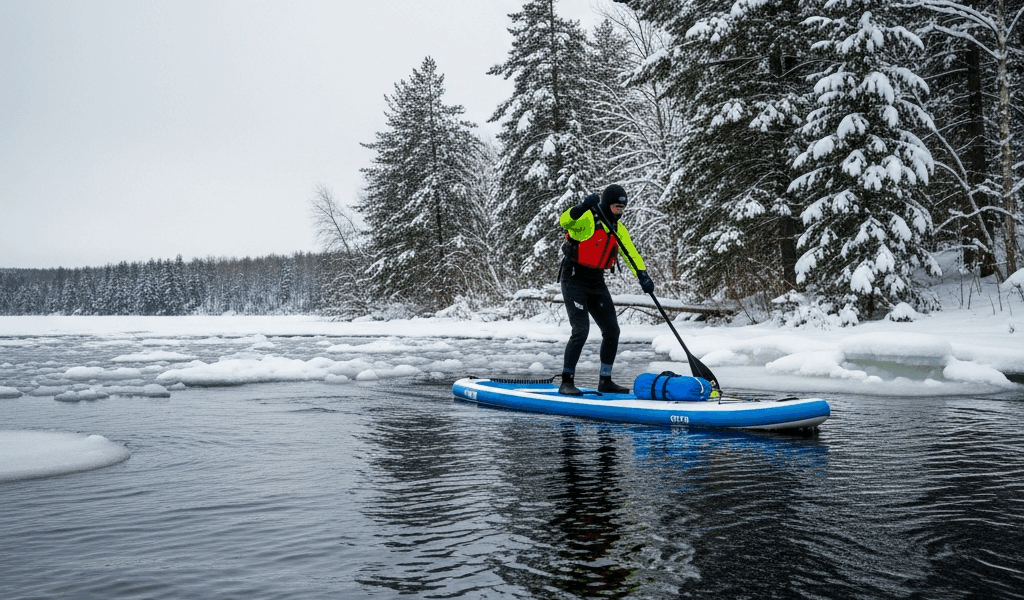
Cold Water Kills — The 1-10-1 Rule
Cold water paddleboarding has gotten complicated with all the conflicting advice flying around. As someone who capsized in a Connecticut river during my second winter on the water, I learned everything there is to know about cold shock firsthand. Today, I will share it all with you.
Here’s the terrifying part: cold water doesn’t care about your skill level. Doesn’t care about your $2,000 board. When I went under that day — February, maybe 48°F water — the gasping hit before I even processed what was happening. My lungs forgot how to work. That was real, and it changed how I approach every single session.
So what is the 1-10-1 rule? In essence, it’s a survival timeline for cold water immersion. But it’s much more than that — it’s the framework that should drive every gear decision you make.
Fall into water below 60°F and you get one minute. Not one minute to climb back on your board. One minute to stop your body from involuntarily inhaling water. Cold shock triggers hyperventilation immediately. Your diaphragm seizes. People drown in this first minute while wearing a PFD, while clutching their board, while technically doing everything right. One minute.
Survive that? You’ve got roughly ten minutes of meaningful movement. Your muscles still fire. Coordination hasn’t abandoned you completely. You can swim, paddle, help yourself. Ten minutes — not thirty, not an hour. Ten. That’s what makes this timeline so brutal for paddlers who think fitness protects them.
After ten minutes, hypothermia starts dismantling you systematically. Shivering gives way to rigidity. Around the one-hour mark, most people lose the ability to keep themselves alive. The real killer, though, isn’t that final stage. It’s minute one. Every piece of gear you own should be selected with that first sixty seconds in mind.
What to Wear Below 60°F Water
Probably should have opened with this section, honestly. I’m apparently the kind of person who learns exclusively through personal suffering — I spent an entire season paddling in a regular rashguard when the water was sitting at 58°F, telling myself I was tough enough. I was also the person who got hauled out of the water shaking so violently I couldn’t work my own zipper. Don’t make my mistake.
Air temperature and water temperature both matter here. Below 60°F water, neoprene isn’t a preference. It’s basic survival equipment.
Wetsuit Selection by Water Temperature
- 50–60°F water: A 3mm to 5mm wetsuit. The 5mm Xcel Infiniti — around $280–320 depending on where you find it — will keep you functional through extended sessions. Thicker neoprene traps more body heat in its cellular structure, simple as that.
- 40–50°F water: 5mm minimum, paired with neoprene booties and gloves. This is where a hooded wetsuit stops being optional. The O’Neill Psycho Tech 5/4mm hooded suit runs $350–400 and it’s worth every dollar.
- Below 40°F: Consider a drysuit instead. A drysuit creates an air barrier rather than relying on trapped water in neoprene — fundamentally different approach. Budget $600–1,200. Non-negotiable below this threshold.
Booties matter more than people admit. I’m apparently a slow learner on this one too — wore thin water socks for years, figured they were fine. Then I lost feeling in my toes after forty minutes on a February morning. Real neoprene booties, something like the 5mm Rip Curl option around $40–60, keep your feet actually functional. Numb feet can’t operate a vehicle pedal. Can’t climb out of water. Can’t perform the movements required to save yourself.
Gloves are the same story. A 3mm or 5mm paddling glove — $30–80 — preserves grip strength and dexterity. Bare hands in 45°F water lose function fast. Your paddle becomes a useless stick if your fingers won’t close around it.
The hood is the detail most cold water paddlers overlook. Your head sheds heat rapidly. A 5mm neoprene hood, built into some wetsuits or sold separately for $25–40, covers ears, scalp, and upper neck. Feels strange for about five minutes. Then you realize you can actually think clearly — that brain-freeze sensation that makes rational decisions impossible just disappears.
PFD Is Non-Negotiable in Cold Water
Wearing a PFD in cold water isn’t about looking cautious to other paddlers. It’s about maintaining the ability to breathe when your body decides to stop cooperating.
I’ve watched experienced paddlers argue they don’t need a life jacket because they’re strong swimmers. Those same people become completely incapacitated during cold shock. A PFD keeps your airway above water during minute one when you can’t control your own breathing. It keeps you afloat during that ten-minute window when your muscles are shutting down. It keeps you alive during the hour when hypothermia is quietly stealing your consciousness. That’s what makes a PFD endearing to us cold water paddlers — it works even when we don’t.
Auto-Inflate vs. Foam — Cold Water Demands Reliability
Two types exist: inflatable and foam-filled. In cold water, foam wins. Full stop.
An auto-inflate PFD — around $150–250 — uses compressed gas or a water-activated cartridge to fill an internal bladder on immersion. Great for kayak fishing, fine for calm warm water. But in cold water, auto-inflate has one brutal flaw: it requires you to function. If cold shock has you gasping and disoriented, the mechanism might not deploy. Some models require manually pulling a ripcord while you’re already fighting to breathe. That’s a terrible ask.
A foam PFD — typically $60–150 — provides buoyancy the instant you hit the water. No deployment. No cartridges. A Stohlquist or NRS foam vest designed for paddling won’t restrict your stroke. It won’t feel like something from 1985. It simply keeps your head up while cold shock is making that impossible to do yourself.
Wear it on your body. Don’t strap it to your board thinking you’ll put it on if conditions change. Cold shock doesn’t give you a dressing window.
Leash Considerations in Cold Water
This is where cold water paddleboarding gets genuinely counterintuitive. A coiled ankle leash — totally standard in warm water — becomes a real hazard below 50°F. So, without further ado, let’s dive in to why.
Warm water scenario: you fall, the leash keeps your board tethered, you retrieve it, climb back on, paddle home. Board equals rescue equipment. Cold water with moving current? That leash becomes a tether to a foam slab getting swept downstream. The board pulls you into faster current. The leash wraps around obstacles. Your incapacitated body gets dragged under.
Leash Setup for Cold Water Conditions
- Still water — lakes, ponds: A straight 9-foot leash is acceptable. No coiling mechanism means less tangle risk, less chance of entanglement if you separate.
- Moving water — rivers, tidal currents: Consider a quick-release waist belt instead of an ankle attachment. If your board is being swept into a hazard, you need to disconnect instantly. A leash-belt system runs $40–80, clips around your waist, connects to the board via a carabiner you can release one-handed.
- Class II current or stronger: Many experienced paddlers skip the ankle leash entirely. Entanglement risk outweighs the benefit of staying attached to the board. Your PFD keeps you afloat. Your skills get you to shore.
Frustrated by the lack of good advice on this, I started researching after a genuinely terrifying moment on the Housatonic River during early April — snowmelt had the current moving noticeably faster than I expected. When I capsized, my board swung into a partially submerged tree. The coiled leash snagged on a branch. For approximately four seconds — which felt considerably longer — I was underwater with the board pinned above me. Those four seconds taught me more about leash selection than any article ever could. I’m apparently a hands-on learner in the worst possible way.
When to Stay Home
Simplest rule in cold water paddleboarding, and the one most people ignore: add your water temperature to your air temperature. Below 120°F combined, reconsider. Below 100°F combined, probably cancel. Below 70°F combined, do not go.
Run the numbers on a real scenario. Water at 55°F, air at 50°F — that’s 105°F combined. Borderline already. Now factor a 15-knot wind. Wind chill drops that 50°F air down to around 35°F. Your actual combined figure is now 90°F. Hard no.
Solo paddling in cold water is the highest-risk thing you can do in this sport. Nobody calls for help during your cold shock. Nobody retrieves your board if you separate from it. Nobody notices if your texts go unanswered for two hours. I don’t solo paddle below 55°F water. Period. The risk-reward math collapses when the only variable you can control is simply not going out.
Cold water paddleboarding is possible — genuinely rewarding, actually. The winter light on flat water, the solitude, the feeling of being capable when everyone else has put their boards away until May. Worth pursuing. But it demands respect, real preparation, and the honesty to recognize when conditions have crossed from challenging into actually dangerous. That recognition is what keeps you alive for thousands more miles on the water.



Stay in the loop
Get the latest sup spots updates delivered to your inbox.