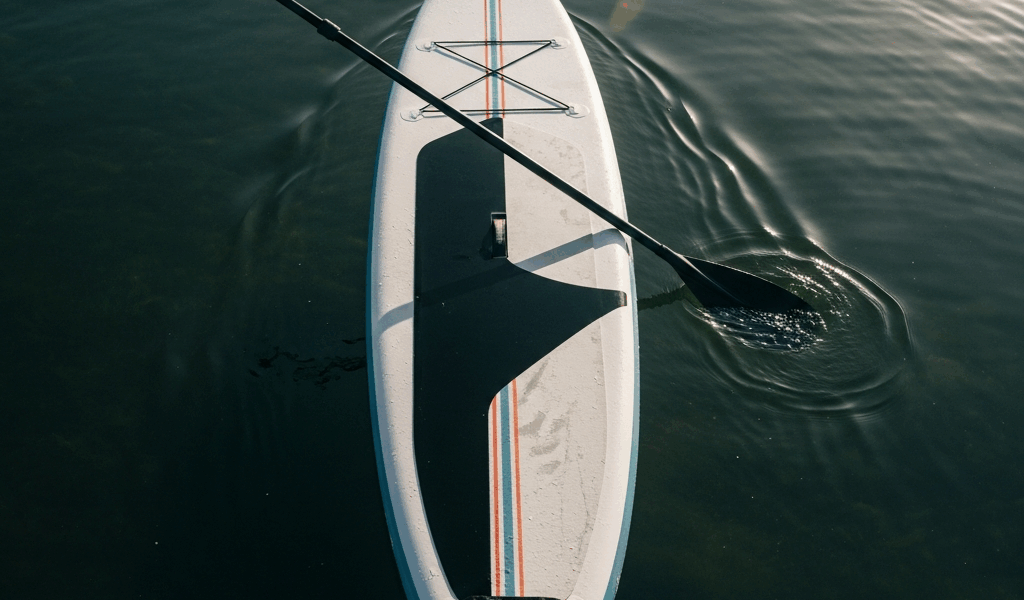
What a Sinking Paddle Actually Tells You
SUP paddling has gotten complicated with all the gear advice and technique noise flying around. But sometimes the problem staring you down is pretty simple — and pretty fixable.
Your paddle keeps sinking on one side. You feel it the moment the blade hits the water. That drag. That flutter. Like one side is cutting through honey while the other moves clean. Maybe it’s the right blade burying too deep. Maybe the left one keeps skimming air. Either way, the board pulls. Your shoulders tighten. You lean to compensate, which — naturally — makes everything worse.
This isn’t a board problem. It isn’t bad luck. A sinking paddle on one side is sending you a specific message: your stroke mechanics are asymmetrical somewhere.
As someone who has logged hundreds of hours coaching beginners and intermediate paddlers on the water, I’ve watched this exact frustration repeat itself more times than I can count. The paddler assumes they need a new board. Or a better paddle. Usually, neither is true. What’s actually happening is one of five mechanical breakdowns — and once you know what to look for, you can fix it before your next session. Today, I will share it all with you.
Here’s the framework: blade angle, grip width, stance, hip rotation, and gaze direction. Run through these in order, on the water, and you’ll find the culprit.
Check Your Blade Angle First
Start here. This fix takes about ninety seconds and solves the problem in roughly a third of the cases I’ve seen.
If your paddle is adjustable — brands like Hydro-Tech and Aqua-Bound make solid two-piece models with feathering settings around the $120–$180 range — an incorrect blade angle creates a pronounced asymmetric pull. The blade face needs to be perpendicular to the water at entry. Even a 10-degree offset generates enough resistance to make that side sink noticeably deeper. That’s all it takes.
Here’s a quick way to verify: find a sunny patch of water and look at your blade’s shadow as you hold the paddle at chest height. It should cast a clean rectangle. If the shadow looks like a parallelogram — or one edge appears thicker than the other — your blade angle is off.
Fixed paddle? The angle is factory-set. But what I learned the hard way: even a “correctly angled” blade can feel lopsided if your wrist rotation during entry is off. Your top hand should stay neutral throughout the stroke — not twisting inward, not twisting out. A lot of paddlers unconsciously rotate the top wrist to compensate for something else entirely, usually a stance issue. That rotation effectively changes the blade face mid-stroke.
Drill for this: hold the paddle out in front of you, arms extended. Both thumbs should point up. Now rotate the paddle forward as if entering the water. That top thumb? Still pointing up. If it rolls inward or outward, that’s your culprit — right there. Do five slow-motion strokes with deliberate wrist neutrality before paddling at full effort.
Your Grip Width and Hand Position Matter More Than You Think
Probably should have opened with this section, honestly.
The shoulder-width rule is foundational. Top hand roughly shoulder-width from the blade. Bottom hand about hip-width below that. Most paddlers naturally get the bottom hand right. The top hand — that’s where everything falls apart.
Too narrow on top — hands bunched together — collapses the stroke arc unevenly. Your arms can’t reach full extension on both sides of the board. One side gets a compressed, abbreviated stroke. The other doesn’t. That compressed side generates more upward resistance. The blade drags. It sinks. Every. Single. Stroke.
Walk this out on land before you test it on water. Stand next to a wall or door frame — I use the side of my garage — and hold the paddle like you’re mid-stroke. Your top hand should span roughly as wide as your shoulder from the blade grip. Step forward into the motion. If your top arm can’t fully extend without your shoulder collapsing inward, spread your hands wider. It’s that straightforward.
The feeling you’re after: both arms should feel equally long and symmetric at full extension. Nothing cramped. Nothing reaching.
Stance and Hip Rotation Are Usually the Hidden Culprits
An offset stance — one foot even slightly forward of the other — limits hip rotation on your back-foot side. That imbalance pushes your back-side arm to overwork, burying the blade deeper on that stroke.
I learned this by obsessing over everything else first. Don’t make my mistake. I checked my blade angle seventeen times over two sessions. Adjusted my grip four different ways. Then a coach watched me for about forty-five seconds and said, “Your left foot is six inches ahead of your right.” That was it. That was the whole problem.
Your feet should track parallel, hip-width apart, centered lengthwise on the board. Even a small forward offset cascades through your entire stroke. Hips can’t rotate evenly. Core can’t engage symmetrically. One side of the paddle drowns.
Reset drill: step off the board entirely. Step back on and plant both feet heel-to-toe first, centered. Take three strokes from that position. The difference is immediate — the board tracks straighter, both blades bite evenly. Then widen to hip-width, keeping that parallel, centered position locked in.
One more thing, and it matters enormously: where you’re looking. Staring down at the deck instead of the horizon rotates your torso forward and shuts down hip rotation. Keep your gaze level — not ahead of you at an angle, actually level with the horizon line. Your torso will follow your eyes whether you want it to or not.
Run Through This Quick On-Water Self-Check
Mid-session, when you feel that sinking drag return, run this five-step sequence without leaving the water. So, without further ado, let’s dive in.
- Blade angle — Find your blade’s shadow. Rectangle or parallelogram? Adjust top-hand rotation back to neutral and check again.
- Grip width — Extend both arms fully as if mid-stroke. Do they feel equally long? Top hand feels bunched? Spread it wider before the next stroke.
- Stance width — Look down. Both feet hip-width, parallel, neither one creeping forward? Shift back to center if they’ve drifted.
- Hip rotation — Take one deliberate slow stroke and feel your ribcage rotate. Both sides should engage equally. If one side feels locked, consciously drive that hip deeper into the rotation.
- Gaze direction — Eyes on the horizon. The moment your gaze drops to the board, your torso follows. Lift your eyes. The stroke opens back up.
Run all five in that sequence. The problem surfaces by step three in most cases — I’d say eight times out of ten.
One last note worth keeping in mind: if you’ve worked through all five and the board still pulls consistently to one side, the issue might not be your paddle at all. A bent or damaged fin creates tracking problems that look almost identical to paddle asymmetry from the outside. That’s a separate diagnostic entirely — and honestly worth checking if the paddle corrections don’t hold.




Stay in the loop
Get the latest sup spots updates delivered to your inbox.